30th April 2026
Below we share a chapter from 'The UNGASS decade in review: Gaps, achievements and paths for reform' published by IDPC in February 2026. The chapter provides a comprehensive overview of global development in legal regulation over the past decade. Thanks to IDPC team, in particular Adrià Cots Fernández and Juan Fernández Ochoa - for their work on this excellent resource. The complete report (including all references) is available to download here, with executive summaries also available in French and Spanish.
1. Evolution over the past 10 years
Since 2016, legal regulation has become a mainstream approach to managing non-medical drug use among adults. By a conservative estimate, over 380 million people now live in jurisdictions where the possession and use of cannabis by an adult for recreational purposes is legal. This marks the most significant shift in global drug policy during this period. Responsible, ethical and rights-based regulation has become a policy option largely promoted by reform-oriented civil society – with a third of the respondents in IDPC’s civil society survey calling for legal regulation.
Countries that have moved to regulate cannabis do so for a variety of goals, which may include protecting public health, cutting into organised crime’s profits, using law enforcement resources more efficiently, promoting livelihoods for traditional growers, addressing the discriminatory impacts of drug enforcement, or simply establishing a new and profitable industry. As a result, regulatory frameworks differ widely across jurisdictions, and their success in promoting health, safety and human rights depends largely on how they are designed.
Instead of facilitating a constructive space for evidence-based discussions on the tensions between legal regulation and the UN drug control framework, the INCB has consistently opposed this shift as a violation of the international drug conventions, whilst debates at the CND have been highly politicised and removed from evidence. This resistance has slowed or blocked reforms in some regions, but it has not stopped the global spread of legal regulation.
Growth in legally regulated markets
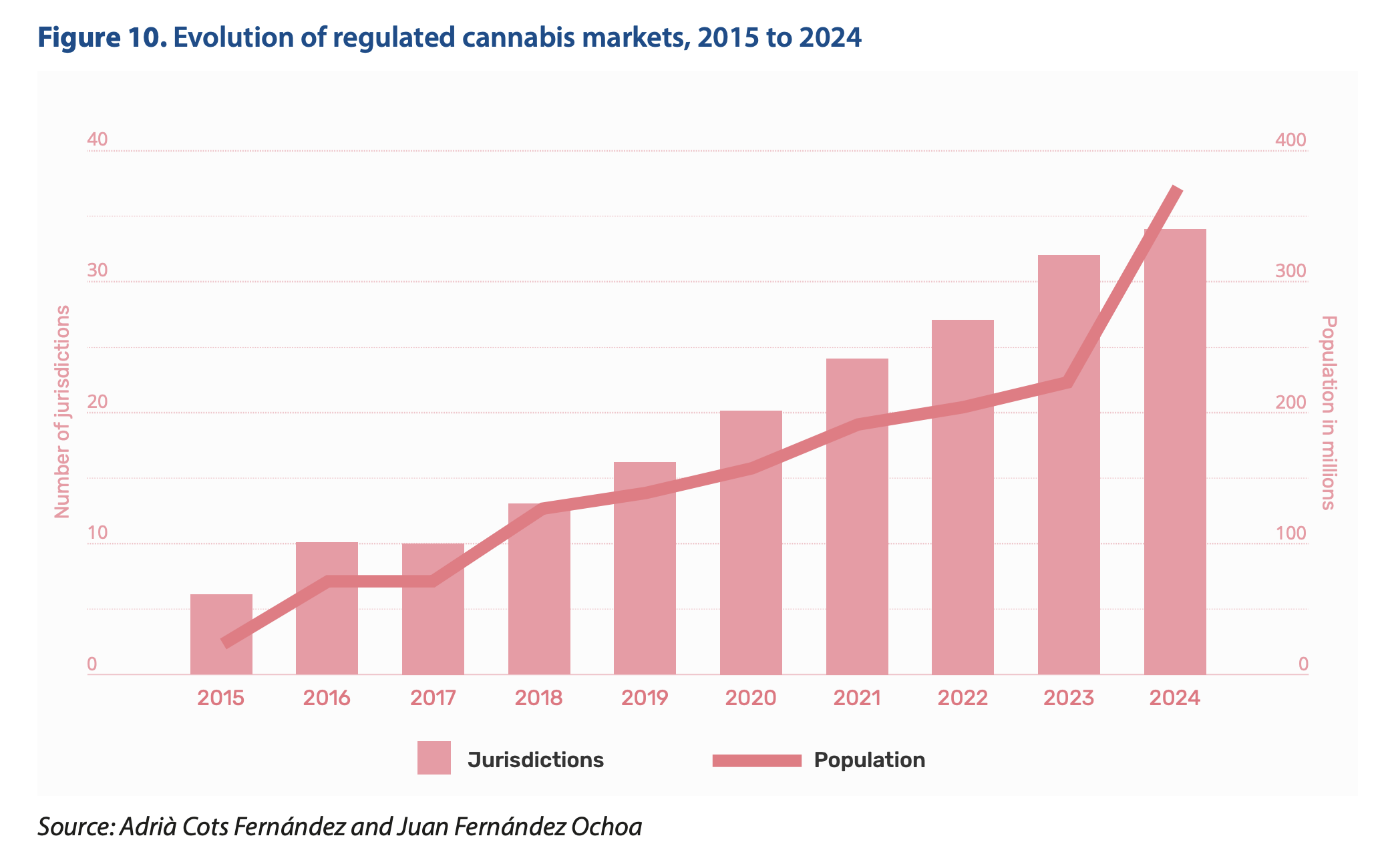
The expansion of legally regulated cannabis markets in the past ten years has been remarkable. In 2015, only six jurisdictions in the world – Uruguay and five US states – had legalised cannabis, in addition to Jamaica having legalised the plant for the Rastafarian community and Bolivia having established a regulated market for the coca leaf. By 2025, Canada, Uruguay and 28 jurisdictions in the USA allowed for the production and sale of cannabis for non-medical use, establishing either commercial or government-controlled systems for production and supply. At the same time, Czechia, Germany, Luxembourg, Malta, and South Africa had adopted ‘regulation-light’ models that allow for home cultivation and possession of limited quantities of cannabis for personal use, and – in the case of Germany and Malta – the establishment of cannabis social clubs.
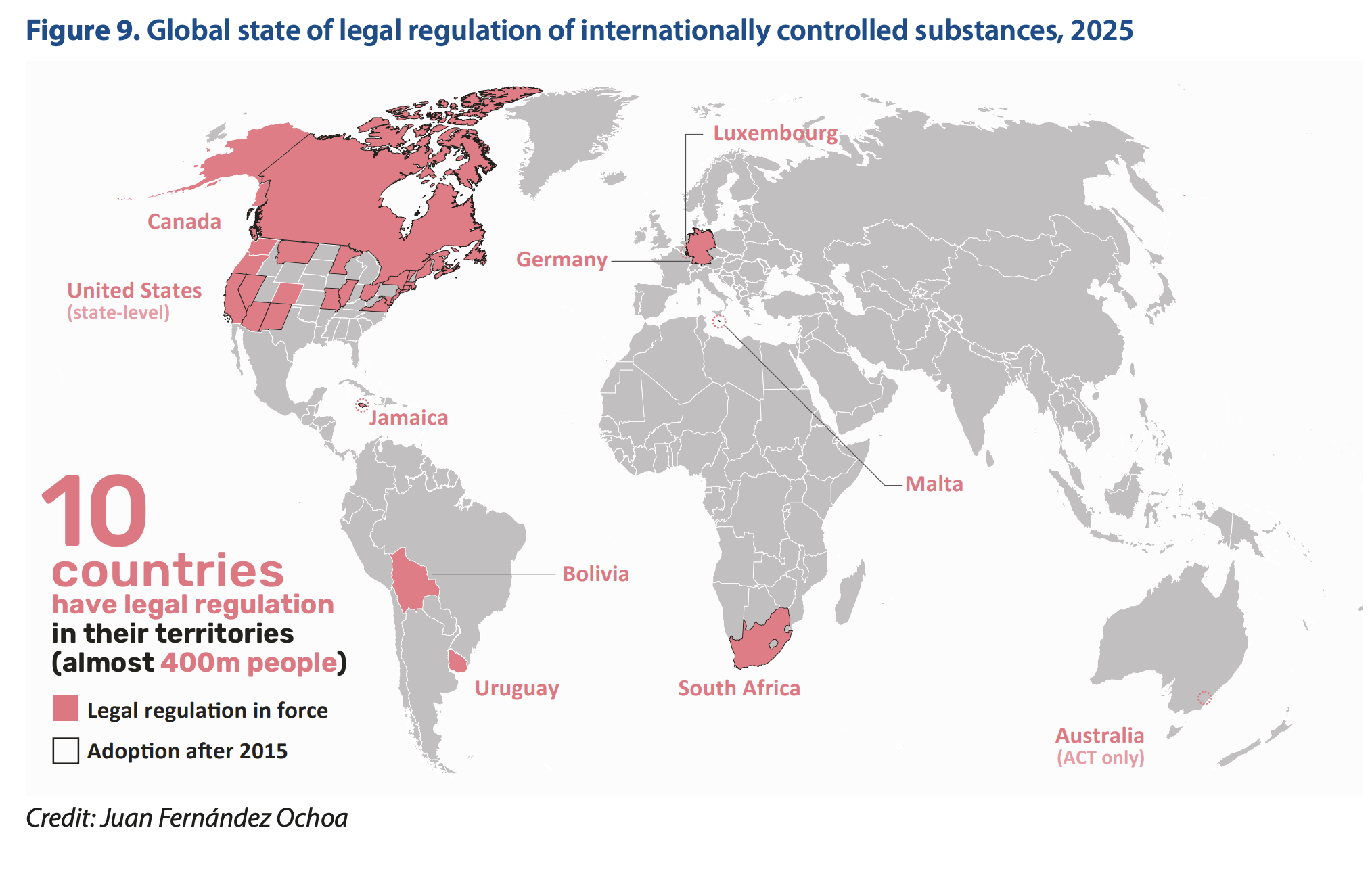
The legal status of cannabis in other jurisdictions is more doubtful. In 2018, the Supreme Court of Mexico ruled that the national law prohibiting the non-medical use of cannabis was unconstitutional. The court also ordered the Mexican Government to formally legalise and regulate cannabis, but the required law has stalled in the legislative process. From 2022 to 2025, Thailand decriminalised cannabis possession and established a medical market that effectively allowed non-medical use due to the absence of a solid regulatory system, leading to the opening of thousands of retail shops; in 2025, the Thai government announced its intention to re-schedule the plant and strictly enforce the medical nature of the market. For now, how this will be implemented in practice remains unclear. Even excluding Mexico and Thailand, from 2015 to 2026 the total number of people living in legal cannabis markets has increased exponentially, from 20 million to over 380 million people (see graphic below)). Remarkably, legal regulation has become a cross-regional trend, with developments in Asia, Africa, Europe, Latin America and the Caribbean, and North America. The renewed interest in psychedelic substances for medical, therapeutic, spiritual, and recreational purposes – often called the ‘psychedelic renaissance’ – may soon drive a new wave of regulatory innovation. In 2020, Oregon regulated the supply, sale and use of psilocybin, allowing adults over 21 to consume it in licensed facilities without needing a prescription or diagnosis, although a preparatory session with a trained facilitator is required. In 2022, Colorado decriminalised personal possession, growing, sharing and use of five psychedelics for adults over 21, whilst still prohibiting sales. Given that cannabis markets started as a spillover from medicinal programmes in the early 2000s in precisely that corner of the USA, this may point to a yet-to-come expansion of regulated markets.
The global drug control regime pushes back
Since 2016, the INCB has been clear in stating that the legal regulation of internationally controlled substances for non-medical and non-scientific purposes contravenes the international drug control conventions, specifically article 4(c), and article 36 of the 1961 Convention, as well as article 5(2) of the 1971 Convention and article 3(1)(a) of the 1988 Convention. The Board has become an outspoken champion of a strict enforcement of the conventions within the UN system. Given its mandate to monitor the conventions, it is understandable that the Board has a clear position on what policy options follow or contravene the treaties. However, the Board has been criticised for refusing to explore pathways that could accommodate regulated markets within the international system, and for biased reporting on the actual outcomes of cannabis regulation, selectively highlighting the negatives and downplaying the positive impacts.
The INCB may employ several strategies to discourage countries from adopting regulated drug markets. These can include consultations and correspondence with governments on a confidential basis, and public criticism through its annual reports. For example, the 2023 and 2024 Annual Reports warned Chile, Colombia, Czechia, Germany, the Netherlands, and New South Wales (Australia) about their plans to explore or pilot legal regulation. The reports also raised concerns about jurisdictions that have already implemented regulatory models. It has been noted that the Board has the authority, under Article 14 of the 1961 Single Convention, to implement enforcement measures that may include recommending an import or export embargo on controlled substances against the country in violation; however, these have not been used so far.
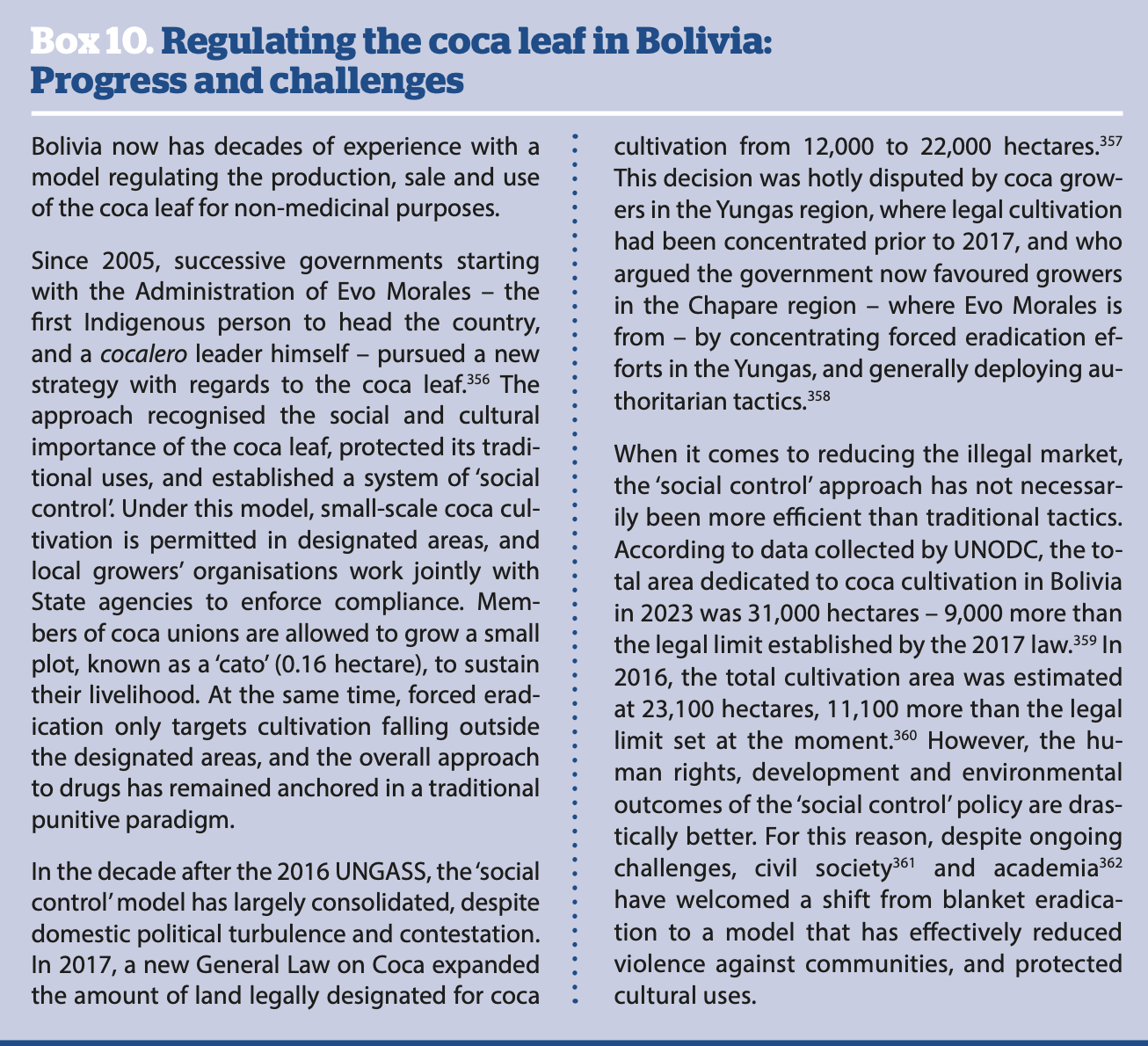
The drug conventions have not prevented several jurisdictions from regulating cannabis markets, but they have slowed or stalled progress in some cases, most notably in the EU. EU legislation requires Member States to criminalise the cultivation, production and supply of internationally scheduled substances and plants ‘when committed without right’. The interpretation of this provision is hotly debated, but the European Commission has made it clear that it would favour a restrictive approach, and that it would consider disciplinary proceedings for breach of EU law if a supply market were to be regulated – a risk that few countries are willing to assume. Furthermore, the Schengen Convention and the European Framework Decision 2004/757/JHA370 both oblige parties to take measures against drug trafficking and to comply with their obligations under the drug conventions. In practice, this has led to the slow down or end of plans to regulate the supply of cannabis in Luxembourg (which had envisaged a supply chain under government control) and Germany (which had considered regional commercial supply pilots), as well as caution in other EU countries. For instance, in February 2022, the Constitutional Court in Italy vetoed a referendum on a proposal to regulate personal cultivation of cannabis and other psychoactive plants, because parts of the proposal would flout international law.
No UN consensus against legal regulation
The INCB and the UNODC remain resolutely opposed to legal regulation, but the same cannot be said about entities in other corners of the UN system. The OHCHR, which over the past decade has been increasingly involved in documenting the human rights implications of drug policy, has recommended that Member States ‘take control of illegal drug markets through responsible regulation, to eliminate profits from illegal trafficking, criminality and violence’ (emphasis added) – notably placed first amongst many other recommendations in the conclusion of its landmark 2023 report. Despite considerable backlash from Vienna, the OHCHR has not budged, and High Commissioner Volker Türk has reiterated this recommendation on several occasions. A few months later, the UN Special Rapporteur on the right to health also recommended responsible regulation. In September 2025, UNDP released a discussion paper concluding that ‘Conventional punitive drug control approaches have proven ineffective or actively counterproductive’ in achieving the SDGs. The paper examines the potential of legally regulated markets as an alternative approach to advance these objectives, inviting the international community to consider how the system ought to be reformed in order to better support sustainable development. Opposition to legal regulation is also notably absent from the UN System Common Position on drugs. Instead, it commits UN bodies to ‘provide Member States with the evidence base necessary to make informed policy decisions and to better understand the risks and benefits of new approaches to drug control, including those relating to cannabis’.
2. Spotlight on progress
Legal regulation is arguably the one area of drug policy that has undergone the most remarkable change over the past decade. This stands in sharp contrast to the policies developed under the prohibitionist paradigm, where improvements in health and human rights outcomes have been rare. This section examines the substantive progress achieved through legal regulation in four key areas: protecting public health, improving human security, promoting human rights, and strengthening fiscal stability.
Progress in achieving public health outcomes
It is difficult to isolate the negative or positive impact of legalisation on cannabis use and use-related harms, as variations in health indicators can be caused by many different factors. Direct comparisons between jurisdictions that have and have not legalised can be misleading, as trends in cannabis use were already different before legalisation. In addition, a major lesson learnt from the past 10 years is that different approaches to regulation, market design, product controls, and implementation will result in different health outcomes.
Whilst the prevalence of cannabis use tends to be higher in jurisdictions that have adopted a regulated model, this was already the case before legalisation. For instance, cannabis use and social acceptance have been rising steadily in Germany from 2012 to 2021, and ought to be seen as a cause rather than a consequence of regulation.
A systematic review of studies in Canada showed an increase in drug use prevalence since legalisation, but noted important limitations due to a lack of consistent data collected before the legal change.381 Although there may have been an acceleration in prevalence and frequency of use immediately after the moment of legalisation, both have now slowed down and plateaued. The reality is that legalisation has taken place relatively recently, and the short-term timeframe cannot provide good evidence on long-term shifts.382
Some actors, including the INCB, have argued that there may be a ‘social contagion’ effect, in that legalisation in a country reduces the perception of risks in other countries, leading to normalisation. However, no evidence has been provided to support the claim.
Research has also pointed out that, in Canada and the USA, cannabis use amongst people under legal age – an important concern in debates around legal regulation – has not grown since legalisation. This is likely because regulated markets are for adult use only.383 Studies on the effects of cannabis legalisation on traffic accidents have produced diverging findings.384 The UNODC has also pointed out that the daily or frequent use of cannabis products, particularly those that are high-THC, is associated with health problems, including psychosis.385
In the last 10 years we have also learnt how, in a regulated environment, legislative and policy techniques can be employed to share evidence-based information on use and how to reduce the possible health risks and harms, provide safer products, and restrict availability. For instance, it has been argued that Uruguay’s model takes a middle path between prohibition and full commercialisation. The government sets strict rules: users must register, can only buy up to 40 grams per month (480 grams per year), and there are bans on advertising, sales to tourists and edible products.386 Research shows that this has improved product quality, as users have moved to consume the flower instead of a dried, pressed product (prensado). Legal regulation is often accompanied with efforts to expand education, prevention and awareness campaigns, including with funding raised through taxing cannabis income.
Evidence indicates that legal regulation has brought easier access to higher-THC products at lower prices. However, the correlation is not entirely straightforward. THC levels have risen significantly in legal markets, but the same phenomenon has been seen in the illegal market. In the USA, average cannabis THC rose from 3.96% in 1995 to 16.16% in 2018. But in Europe, where cannabis remained illegal, THC content in cannabis increased by 40% between 2010 and 2019, whilst that of cannabis resin nearly tripled. In 2025, demand for higher-THC cannabis pushed the Government of Uruguay to authorise a stronger variant in order to attract consumers away from the illegal market. At least in that case, therefore, the demand for stronger cannabis originated in the illegal market, not as a result of legalisation.
Furthermore, legal regulation allows policy makers to control the quantity of THC content in cannabis products. For instance, whilst in British Columbia less stringent laws allow for cannabis dried flowers with THC concentration to go over 40%, Quebec caps THC concentration in cannabis at 30%, the strictest limit amongst Canadian provinces.
Progress in achieving security outcomes
Reducing the funding and resources that drug trafficking provides to organised crime is often cited among the main reasons for moving to a regulated market. There is a lack of direct evidence on how legalisation itself has impacted the operations of actors in the illegal economy. However, the success of the formal economy in taking over market share is often seen as an indicator of increased public safety, as it means less income for illegal groups. The growth of the legal market also reduces contact between cannabis buyers and illegal sellers, thus increasing safety and reducing risks for people who use drugs.
In the past ten years, the success of legal actors in capturing cannabis markets has depended on several complex factors, including how national policies are designed, how easily consumers can access legal products, the types of products available and their price, how profitable it is for private actors to get involved, and how entrenched the illegal industry has become.
That said, there seems to be a trade-off between establishing strict regulations for legal cannabis access and the formal market’s ability to capture market share. Heavily controlled frameworks like Uruguay’s – which requires drug user registration and offers limited product variety – are often less successful than the commercially-driven models in North America. Similarly, frameworks that rely on self-cultivation and non-commercial supply make the plant harder to access through legal means, keeping the illegal market attractive. This applies to Luxembourg and will likely be the case for Czechia and Germany – in fact, an initial evaluation in Germany found that cannabis production in cultivation associations accounted for less than 0.1% of total demand in 2024.
Several commercially-driven legal markets have been highly successful in capturing cannabis markets. In Canada, the legal market capture in 2022 was estimated at 78%, with a total of CAD 5.2 billion spent on cannabis from legal sources and 1.49 billion from illegal sources. This represents a remarkable success after five years of the legal market, considering that at the end of the first year the legal share was only at 24%. Arguably, this means that illegal groups are losing billions of Canadian dollars in income every year.
Success in US jurisdictions varies greatly. In California, the legal market capture was estimated in 2024 at 40%, with reports of legal operators struggling against low prices, high fees and excise taxes, and a thriving illegal industry that can rely on outdoor cultivation. In Washington State – one of the first jurisdictions to regulate cannabis – the legal market share is estimated at between 60 and 70%. Commercially-driven legal markets, however, run the risk of being overtaken by corporate conglomerates, often operating transitionally and representing the interest of Global North countries, to the detriment of legacy operators and the communities traditionally involved in the illegal market and most impacted by punitive drug control. For example, the communities that have historically been involved in cannabis cultivation are often excluded from the medical cannabis industry, while Black and Indigenous people are underrepresented in Canada’s recreational cannabis market. Large corporations can also exert undue influence on State regulations, for instance in relation to advertisement, marketing and product specifications, as well as on the protection of the environment.
This was one of the reasons why Uruguay opted for strict State controls over its legally regulated market for cannabis. According to government data from 2024, 37% of people who use cannabis access the substance through legal means. Research also indicates that a significant part of those who access cannabis illegally do so through the ‘grey market’, that is cannabis diverted from the legal market. The market share of cannabis grown outside Uruguay went from 58% to 6% from 2014 to 2024. The Government of Uruguay has claimed that 50% of the market share is legal, and has prided itself in keeping USD 25 million per year ‘out of the hands’ of organised crime. At any rate, data from Uruguay indicates that frequent cannabis users have reduced their contact with illegal dealers and selling points, making cannabis use safer than it was before the reform.
Progress in achieving human rights outcomes
The protection of human rights has been cited by countries like Germany and Uruguay as a reason to consider the legal regulation of cannabis. International human rights obligations have also been offered as a legal justification to bypass the obligation to prohibit the supply and use of internationally scheduled drugs. Since 2016, cannabis regulation has already shown clear progress for human rights in three areas: rights linked to personal autonomy; reduced contact with law enforcement – particularly for communities that have been disproportionately policed; and social equity and reparation of prior human rights violations linked to the ‘war on drugs’. Although side-stepped in international debates and mischaracterised as the ‘human right to use drugs’, the category of rights that protect privacy and bodily autonomy is highly relevant to cannabis regulation, and has driven direct policy change. In the past 10 years, national courts have established that the prohibition of the personal use of cannabis infringed upon such rights. Cases that have moved legal frameworks into regulatory or quasi-regulatory spaces include decisions by the Supreme Court of Mexico (with reference to the right to personal development), the Constitutional Court of South Africa (with reference to the right to privacy), and the Eastern Caribbean Supreme Court (with reference to the right to privacy and to freedom of conscience).
A key learning from the past decade is that legal regulation has been remarkably successful at reducing contact with law enforcement for people who use cannabis, as the number of arrests for cannabis possession has collapsed after legalisation. This holds huge promise for improving the human rights costs of drug control, as 4 million people are estimated to be in contact with law enforcement for drug possession for personal use every year,408 and cannabis is the substance that is mostly used to justify such contact. Reducing contact with law enforcement is critical to improve human rights outcomes related to drug policy, as it reduces the likelihood of arbitrary deprivation of liberty, and of a host of harmful police behaviours, including intimidation, stop and searches, abuse, ill-treatment and violence.
In Canada, cannabis legalisation significantly reduced criminal charges for adults. Before legalisation in 2017, 16,697 adults were charged with cannabis-related offences — a rate of 57 per 100,000 adults. Two years after legalisation in 2020, only 2,550 adults faced such charges, dropping the rate to 8 per 100,000 adults. This represents an 85% decrease.
In the US state of New York, cannabis possession arrests dropped from over 43,000 in 2012 to less than 1,000 in 2023.410 Similarly sharp decreases are documented in other US states.
In Germany, the number of consumption-related cannabis offences dropped by 64.6% from 2023 to 2024, after the ‘regulation-light’ model was adopted in April 2024.411 This means that there were at least 110,000 less instances of contact with the police.
Racial and ethnic disparities in cannabis arrests, however, have persisted across all jurisdictions even after legalisation. Nonetheless, the overall decline in the absolute number of arrests has particularly benefited communities that were previously subject to disproportionate policing.
From the late 2010s onwards, a small but growing number of regulatory frameworks in North America have sought to include an important social equity dimension in cannabis markets. This represents a radical break in drug policy, as it is one of the first times that authorities explicitly recognise the harms that the ‘war on drugs’ has caused to certain populations – particularly Black and Brown communities – and seek to provide redress. The instruments for reparation include expunging prior convictions, establishing a fair and equitable legal industry, and creating targeted investment programmes that benefit affected communities.
The most remarkable and effective part of this reparatory framework has been the erasure of criminal records. As of 2025, it is estimated that in the USA alone over 2 million cannabis-related cases have been sealed or expunged. Officials in Missouri announced that the state had expunged over 100,000 criminal records since legalisation, whilst in Connecticut the figure was 43,000. Given the devastating impact of criminal records on the enjoyment of crucial rights such as employment, education, housing and access to welfare, the positive consequences of these measures are significant.
At the same time, many US states have introduced policies to ensure that communities disproportionately affected by the ‘war on drugs’ can take part in the legal cannabis market. Measures include reserving a proportion of business licences for individuals from over-policed communities and permitting people with prior cannabis convictions, including for supply, to operate legally. Additional support has been offered, such as assistance with regulatory compliance for marginalised communities.
The impact of these policies remains uncertain, as many social equity participants continue to face barriers such as limited access to capital, complex compliance requirements, and competition from unregulated sellers. Nevertheless, these developments point to a different way of thinking about cannabis as an engine of social welfare, rather than of harm.
Progress in achieving tax outcomes
The fiscal benefits of establishing a legally regulated market for non-medicinal use are typically not the main reason why such markets are created, but they are a welcome addition. In the 10 years since the 2016 UNGASS, we have learnt that this benefit is significant in jurisdictions where supply falls within their legal framework – either through regulated commercial supply or government-controlled distribution. ‘Regulation-light’ models centred on home cultivation or associations/clubs are very unlikely to generate tax revenue, since production is driven by not-for-profit actors.
Uruguay provides a good example. Access to cannabis in the country must take place through one of three means: home growth, non-profit cannabis social clubs, and licensed commercial pharmacies (as of 2024, 38 of them). However, retail sales in pharmacies are not subject to any specific sales or excise taxes. This means that overall, the fiscal benefit from the cannabis industry is negligible.
In contrast, in 2024 alone, US states that have legalised cannabis generated more than USD 4.4 billion in tax revenue. Seven states generated more than USD 200 million in income, and California alone received over USD 1 billion. In Canada, in the fiscal year ending on 31 March 2024, federal and provincial governments earned CAD 2.2 billion from the control and sale of cannabis – over 12% growth from the previous year.
Income generated through cannabis sales typically represents between 0.5% and 2% of total US state revenue, with Michigan and Nevada standing out at over 3%. In Canada, the share of the budget is typically smaller, under 0.5%. Whilst this will not alter the overall fiscal balance in a jurisdiction, it represents a significant source of income with the potential to grow as the illegal market shrinks.
In Canada, income from cannabis taxation is added to the general budget, with the exception of Quebec, where some cannabis-derived funds support drug prevention and research programmes. In the USA, the more common approach is to earmark cannabis tax revenue for specific, often politically popular or socially significant programmes. This strategy creates a tangible link between the new framework and a widely recognised public good. Across several US states, income generated by taxes on regulated cannabis has funded Medicaid, education, school construction, housing, roads, early literacy, bullying prevention, behavioural health, alcohol and drug treatment, conviction expungement expenses, and reinvestment in communities that have been disproportionately affected by cannabis prohibition, amongst many others.