28th May 2026
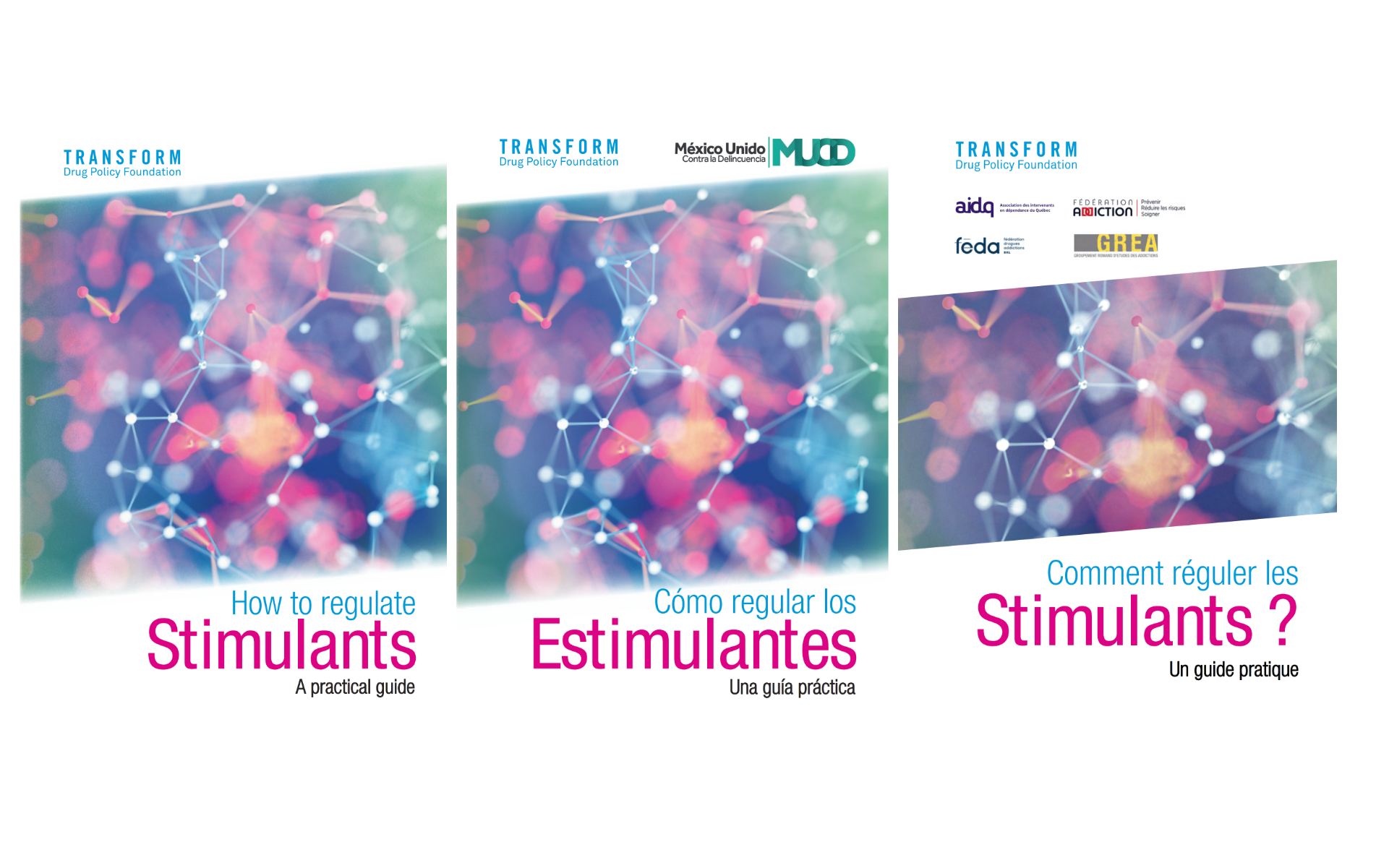
Transform are pleased to announce the publication of the new French translation of How to Regulate Stimulants, A Practical Guide, first published by Transform in 2020 - which we hope will positively inform ongoing reform debates across the French speaking world. The new French edition joins Spanish editions previously published in Colombia and Mexico, and the soon-to-published Portuguese edition being published in Brazil.
We give our heartfelt thanks to the coalition of organisations that supported the new French edition, led by Groupement Romand d'Études des Addictions (GREA) in Switzerland, in association with, Fédération bruxelloise des institutions spécialisées en matière de drogues et addictions (féda bxl) in Belgium, Fédération Addiction in France, and Association des intervenants en dépendance du Québec (AIDQ), Canada.
Below we have translated into English the new foreword for the French Edition from Ruth Dreifuss, founding member of the Global Commission on Drug Policy and former President of Switzerland, and the new introduction for the book from our colleagues in Switzerland, France, Belgium and Quebec.

New foreword by Ruth Dreifuss
Founding Member of the Global Commission on Drug Policy
Former President of Switzerland
The global approach to drugs has long been dominated by prohibition, yet decades of experience show that this strategy has failed to achieve its goals. Prohibition has not prevented drug use, but has instead contributed to more dangerous products, riskier behaviours, and disproportionate harms to vulnerable communities. The poorest and most marginalised are often the hardest hit, particularly in areas where illicit drug production and trafficking are concentrated.
Over recent decades, harm reduction, decriminalisation, and evidence-based treatment have demonstrated their effectiveness, yet too many harms remain rooted in prohibition itself. Drawing on my experience in public service and global policy, I am convinced that reform is urgently needed. Policies must be guided by public health, human rights, social justice, and sustainable development, rather than ideology and punitive enforcement.
A critical first step is to end the criminalisation of people who use drugs. Decriminalisation is increasingly adopted worldwide and has been supported by the 2019 UN Common Position on Drugs, yet it addresses only part of the challenge. The illegal drug market continues to flourish under prohibition, and regulation offers a pathway to reduce harms while ensuring public safety. Legal regulation of adult-use markets is not an endorsement of drug use, but a pragmatic means to protect health, promote justice, and empower communities.
This book provides a timely and practical contribution to the discussion on stimulant regulation. It presents clear principles and pragmatic proposals for managing substances that are often marginalised in the policy debate, despite growing social and health challenges. I welcome its emphasis on context-specific approaches and the responsible balance between public health, safety, and personal freedoms.
I hope that readers will use this work as a foundation for thoughtful dialogue and action. Meaningful reform requires courage, evidence, and collaboration across sectors and communities. The path forward is neither simple nor uniform, but it is essential if we are to create drug policies that safeguard health, respect human rights, and advance equity for all.
New Introduction to the French edition
by, Romain Bach Groupement Romand d'Études des Addictions (GREA), Switzerland, Stephane Leclercq Fédération bruxelloise des institutions spécialisées en matière de drogues et addictions (féda bxl), Belgium, Marie Öngün-Rombaldi Fédération Addiction, France, Sandhia Vadlamudy Association des intervenants en dépendance du Québec (AIDQ), Canada
A Reality That Can No Longer Be Ignored
Stimulant use — cocaine, amphetamines, MDMA — now cuts across the whole of our French-speaking societies. This reality, long confined to the margins of public debate, is now asserting itself with renewed urgency. Patterns of use are diversifying, the profiles of people who consume substances are extending well beyond traditionally identified categories, and the motivations are growing more complex: the pursuit of professional performance, stress management, social connection, or simply adapting to the demands of a world in constant acceleration.
This expansion reflects deep-seated needs within contemporary societies. The notable rise in cocaine use, observable across the entire French-speaking world, reflects a social transformation that goes far beyond the question of substances themselves. At the same time, the alarming increase in overdose deaths — particularly pronounced in Quebec — reminds us of the urgency of an adequate response.
The illegal stimulant market, in constant flux, escapes all health oversight. Variability in quality, frequent contamination, and the emergence of ever more concentrated substances all constitute serious public health risks. In the face of this reality, our institutional responses remain fragmented, often limited to repressive approaches whose ineffectiveness no longer needs to be demonstrated, or to harm reduction initiatives which, however essential they may be, amount to no more than an insufficient stopgap.
Regulation: A Necessary Path Towards Health and Justice
The time has come to recognise that the alternative to public, democratic regulation is not an absence of markets, but rather their de facto management by criminal organisations. This reality, however uncomfortable, compels us to move beyond the political taboos that still obstruct any serious reflection on the regulation of psychoactive substances.
Legal regulation represents far more than a simple policy alternative: it constitutes a fundamental lever for public health and social justice. Unlike prohibitionist approaches — which have demonstrated their inability to prevent use, protect population health, or curb the violence associated with illegal markets — regulation offers the possibility of effective, transparent, and democratic control.
This approach cannot be uniform. Each substance calls for specific regulatory arrangements, tailored to its pharmacological properties, its social uses, and its particular risks. More fundamentally still, any regulatory policy must be co-constructed with the people directly affected, in recognition of their experiential expertise and their fundamental rights.
Regulation cannot, however, be considered in isolation. It must be coherently articulated with ambitious prevention, harm reduction, and therapeutic support policies. It is in this integrated approach that the promise of a truly effective and humane drug policy lies.
An International Context in Profound Transition
The international landscape of drug policy is currently undergoing unprecedented transformation. Since the United Nations General Assembly Special Session (UNGASS) in 2016, we have witnessed a gradual but undeniable paradigmatic shift, placing public health, human rights, and social development at the heart of the agenda.
The renewed recognition of the coca leaf as cultural heritage and medicinal resource — reaffirmed at the Commission on Narcotic Drugs and more recently at the 2025 Harm Reduction International conference in Bogotá — illustrates this evolution in thinking. It invites us to fundamentally rethink our relationship with psychoactive substances, acknowledging the diversity of their uses and the complexity of their social and cultural meanings.
The year 2024 marked a decisive turning point with the visible erosion of the Vienna consensus, which had long served as the ideological foundation of the international prohibitionist regime. This questioning opens unprecedented possibilities for policy innovation. More significantly still, the United Nations Commission on Narcotic Drugs launched a historic review of the international drug control system in 2025, thereby creating an institutional space conducive to reflection and reform.
In this context of change, the question of stimulant regulation — paradoxically absent from major international debates despite its growing importance — deserves to be raised with force and clarity. It is precisely this gap that the present work intends to address.
An Essential Contribution to the French-Speaking Debate
How to Regulate Stimulants aims to be an indispensable resource for all those engaged in this crucial reflection: policymakers in search of pragmatic solutions, frontline practitioners confronted daily with the limits of the current system, people with lived experience whose expertise is too often overlooked, and researchers committed to informing the debate with evidence.
This work does not claim to offer ready-made solutions, but rather proposes concrete, well-founded, and nuanced directions for building a differentiated, credible regulation firmly grounded in a public health perspective. The aim is to foster constructive dialogue, to move beyond dogmatic positions, and to imagine collectively the policies equal to the challenges of our time.
Faced with the social, health-related, and environmental transformations that characterise our era, standing still is no longer an option. Fragmented and ideological approaches have shown their limits. It is time to develop integrated strategies, grounded in scientific evidence and anchored in the realities lived by communities.
To regulate psychoactive substances is, ultimately, to equip ourselves with the means for a more just, more effective, and more humane public action. It is to recognise that the question of drugs is not, first and foremost, a matter of security or morality, but rather a public health and social cohesion issue. It is, finally, to affirm our collective capacity to build rational, compassionate, and courageous public policies — equal to the challenges of our time.