27th July 2026
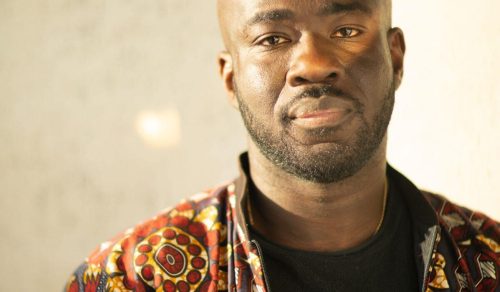
Interview with Kojo Koram: Getting Legal Regulation Right
We sat down with Kojo Koram, professor of Law at Loughborough University and co-founder of the Transnational Research Centre on Emerging Drug Markets to discuss his new book, The Next Fix: The Winners and Losers in the Future of Drugs.
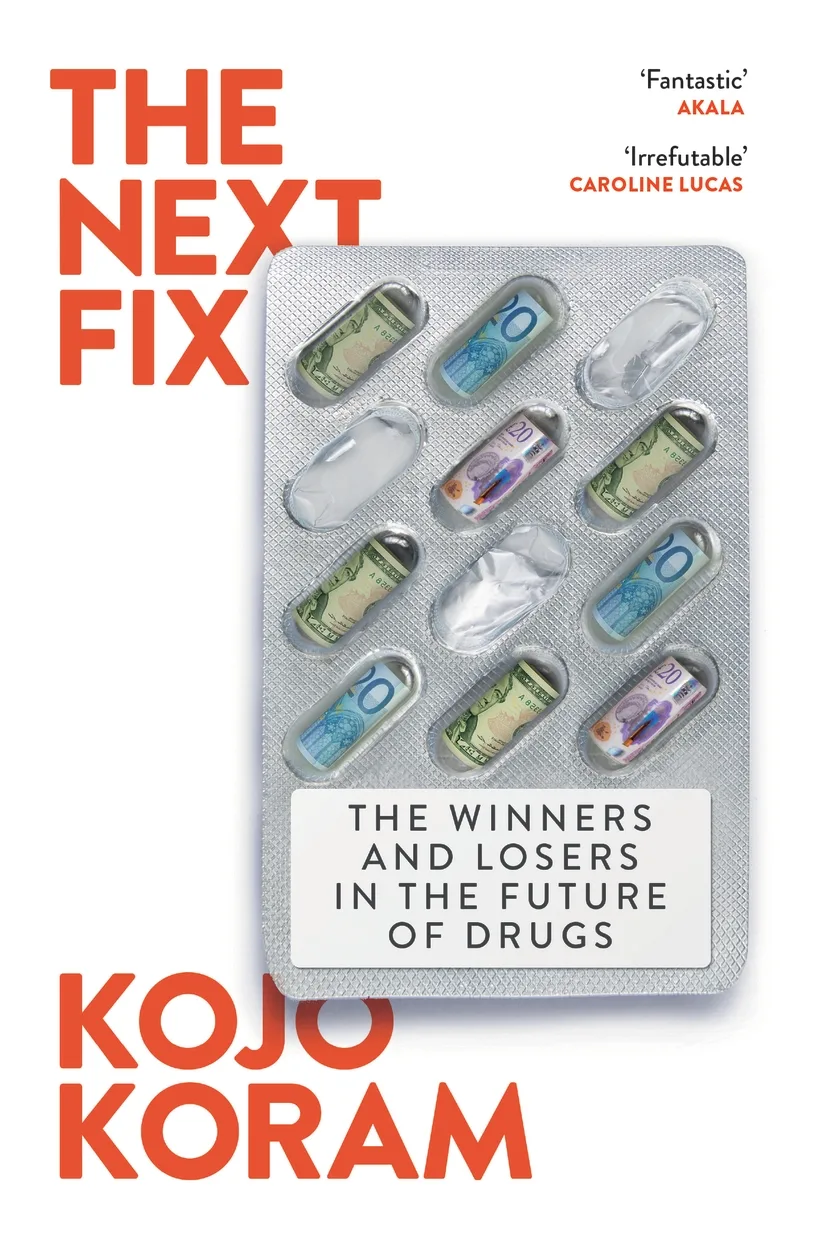
Mary: Tell us about your new book! What does it bring to the drug policy reform debate?
Kojo: I wrote The Next Fix really in order to investigate all the changes that have happened with drug policy, particularly in the past decade. For most of the 20th century we received a single defining story of the ‘war on drugs’, that there were certain drugs that were so inherently dangerous they could only be criminalised.
But over the past decade, especially since Colorado and Washington states' legalisation of non-medical cannabis in 2012, we've had this swathe of drug policy reforms – decriminalisation, legal regulation, social equity focused regulation models, non-commercial models of legal regulation including cannabis social clubs, and all different types of harm reduction initiatives. There has been a real fragmentation of that single story of the ‘war on drugs’.
Meanwhile, in the UK, there has been a big discussion about what would happen if we legalised drugs, and would there be chaos in the streets? As though that’s not already happening under prohibition.
I thought that entire discussion was being held in the absence of the recognition that many of these changes are already happening in a number of jurisdictions across the world. What I want to do with this book is to travel to different countries that have implemented different drug policy reforms over the past decade and see what the social and political consequences are. And perhaps most significantly for me, as a professor of law and political economy, is how law shapes different markets and creates winners and losers in material terms, and what were the economic consequences of changing our laws.
Mary: I’m really interested to hear more about the social equity focussed models for cannabis regulation you mention. What are some of the most inspiring and successful examples you observed and think should be celebrated?
Kojo: I've been working in the drug policy field since I came back from working as a lawyer in the US and seeing how maximum-security prisons are sustained by drug offenses over there – as I write in the introduction to the book. I immediately started working for [drug legal service providers and reform advocates] Release in 2012.
And over the past decade or so, what's really exciting is how this has become a space where all these different experiments, or you might call them initiatives, around how we use laws to facilitate economic justice, environmental justice, and even reparative justice, are happening through drug policy reform. So, drug policy reform has become much more than just the question of can you or can you not take a particular drug.
Some of the most inspiring examples that I've come across are in the city of Albuquerque, where they are funding a universal basic income project through the tax revenues generated from the legalisation of cannabis.
In the city of Evanston in Illinois, they have introduced the first municipal reparations programme in the USA funded through cannabis tax revenue. This means reparations directed towards the racially disproportionate harms of the drug war. These include reparations around housing, being funded by the commercial revenue from the legalisation of cannabis. Is that going to be successful? That's an open question at the moment, because that programme is actually being sued by the Trump administration the last time I looked, to try and close it down.
There are also interesting initiatives around forms of cooperative ownership and worker-owned dispensaries in Rhode Island, for example, where they have embedded into the law a requirement that 25% of the cannabis licenses given out are going to worker-owned cooperatives.
In so many other industries, whether it's tech or fossil fuels, we're talking about how we can democratise corporate power and allow workers to get a greater say within the ownership of the actual products they supply. With these new emerging markets around cannabis we have the opportunity to include this from the beginning.
There's a big discussion around psychedelics which accelerated over the course of writing the book. There's a lot more interesting initiatives especially when you start looking at the Global South. I think anybody who is interested in economic racial, or environmental justice, should be thinking more about drug policy reform as we move into the 21st century.
Mary: Yes, there’s a massive conversation we need to be having around what drug war reparations could look like beyond financial compensation. In Europe we are starting to see the cannabis social club model being introduced in places like Germany and Malta, what are your thoughts on that model?
Kojo: I spent some time looking at Barcelona where the social club model has been allowed to emerge in a de facto way over the past couple of decades. And then as you say, it has since been adapted for the German legalisation model, partly due to restrictions of EU law (that don’t allow US-style commercial retail), and partly because of recognition of the potential dangers of some over commercialised retail models, that have been fast tracked throughout North America with legalisation.
Legalisation doesn't have to mean commercial retail, there's many different forms of how you might produce, distribute, and consume a product. And the cannabis social club is a member-based, participatory, often localised, community-based model of consumption, production and distribution. They can also have a fantastic educational quality, where the members of the social clubs learn about how to cultivate the plant, different plant strains, THC-CBD balances, and harm reduction; all the things that you're unlikely to learn if you're just a customer walking into a dispensary and paying for a product.
There's great potential in that, but we also need to be thinking about the global reparative justice element of cannabis reforms. Social clubs in Europe don't necessarily benefit the cannabis farmer in Jamaica, or the hash producer in Morocco, or other communities that have historically provided cannabis for the illegal market and been key targets of enforcement.
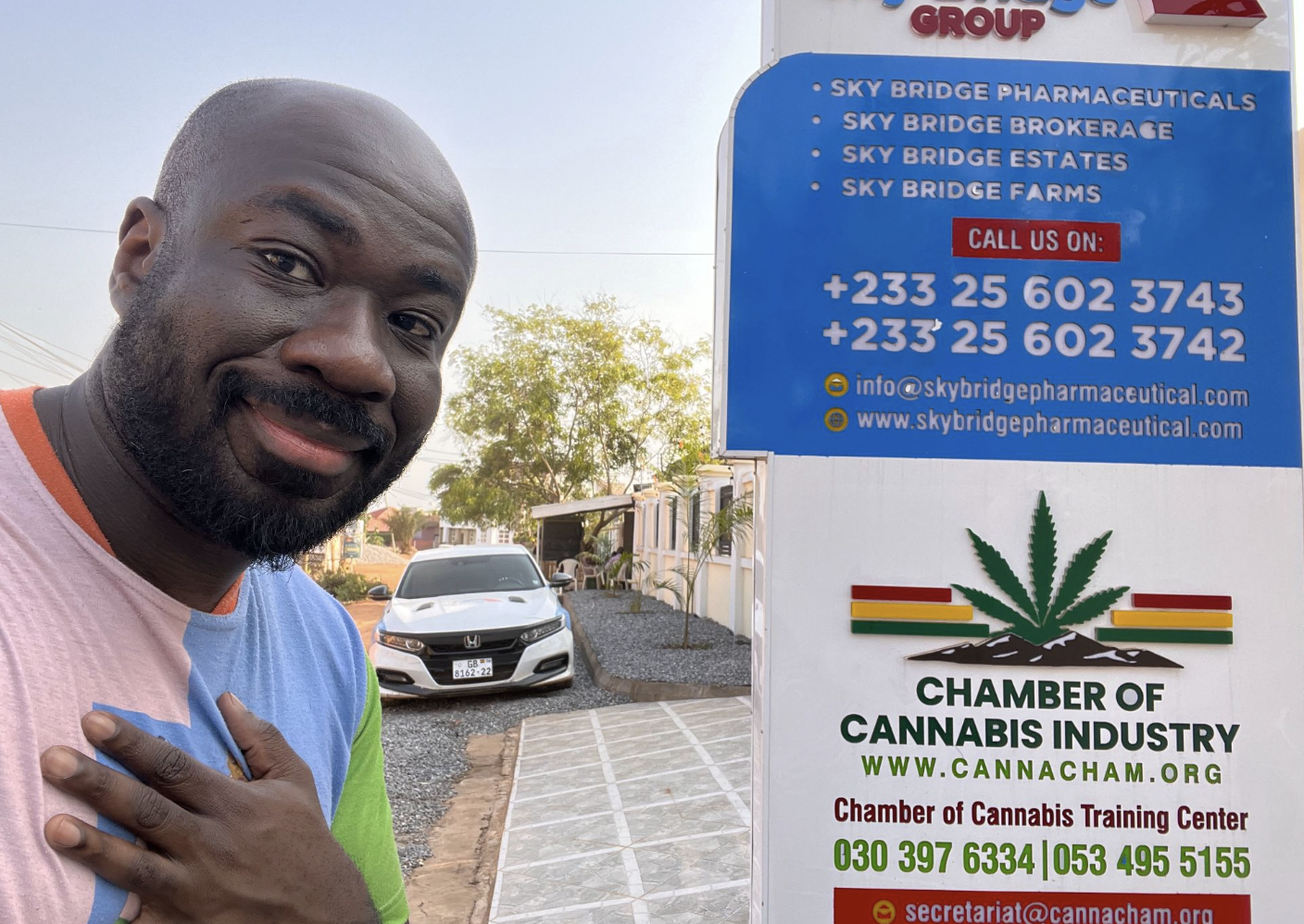
Kojo visiting Ghana’s cannabis commerce
That’s not inevitable. There is a way to shape social clubs to have cross-border solidarity, but I think that's an important thing not to ignore when we look at regulatory models for localised production and consumption. We need to remember that the drug war is a global project. Ending it, and making reparations, needs to be global as well.
Mary: I’m really glad you brought that up; do you think that it would be unjust if the UK were to legalise cannabis and start profiting from a legal domestic market while it remains illegal and criminalised in traditional producer countries in the global south? Should our advocacy be more focussed on reforms to the United Nations treaties and establishing such trade agreements before we legalise domestic cannabis and other drugs?
Kojo: I think it would be great to reform the treaties first, but it does sound very ambitious particularly when we think about slowly international legislation evolves. The reality is that international drug prohibition didn't emerge through international consensus. It emerged through a small number of states agreeing to a certain form of prohibition. In particular, the USA drove it as one of its foreign policy initiatives by the turn of the 20th century; it mandated for core states, if they wanted to become a member of the League of Nations [the fore runner of the United Nations], to sign the 1912 Hague Opium Convention. This forced states to enter into the convention, and then once that critical mass had been built up, it became the legislation and treaties that everyone needs to sign up to, in order to be seen as a valuable member of the international community.
I do think change comes from states not the other way around, but the point that you make of, well, would it be right for there to simultaneously be international criminalisation and enforcement and domestic commercialisation within the West, that is a particularly dystopian future that we are moving into. We are seeing in the US how militarised foreign policy interventions are again being justified under the banner of drug enforcement, while at the same time, these same institutions are fast tracking the commercialisation of cannabis and psychedelics domestically.
Mary: We are working together on a new project which is concerned with how current drug policy in the UK is disproportionately affecting black and other racially minority communities. What else needs to be done alongside legalisation and regulation to address this?
Kojo: The first thing to do would be to bring racial justice groups into this conversation who have been very absent in drug policy reforms internationally and very siloed in the UK. In comparison to the US, where the real momentum for legalisation came from racial justice groups who made it clear that the ‘war on drugs’ has been a weapon of mass surveillance, mass incarceration and persistent over-policing of minority communities.
We always present that as an American problem, but the 2017 Lammy Review - an independent review into the treatment of, and outcomes for Black, Asian and Minority Ethnic individuals in the criminal justice system - emphasised that we've actually had more people arrested or imprisoned from black communities as a proportion of their overall population than in the US. And this is in government review! It’s an acute problem in the UK, and the UK has not done a great job of bringing together drug policy reform – which has been a very white movement – and the racial justice movement.
When cases like Child ‘Q’ happened – this was the case of the Stop and Search [including a strip search] of a 15-year-old black girl from Hackney on suspicion of drug offences – that should have been something that the entire drug policy reform movement was banging the drum about. Child Q is also a child victim of the drug war in the same way that the fantastic families that we support in Anyone's Child are, and others whose children have been victims of the drug war.
The first thing the UK needs to do is to facilitate a movement and make the argument that when reforms come, there shouldn't be legal cannabis retailers or private cannabis clinics being run for profit at the same time the people are sitting in prison on small-scale cannabis possession or supply offenses. Those two realities should not be able to coexist.
Mary: Regarding medical cannabis, as you say, we're seeing corporate organisations monopolise the market, pharmaceutical companies, tobacco and alcohol companies as well. What can we do in the UK to mitigate risks of corporate capture of a future recreational cannabis market? Could we learn from the social equity programmes and licensing provisions you mention in the US?
Kojo: Absolutely, it’s all about how you draft the laws. There's been this explosion in the last couple of years of the private medical cannabis industry. The Sunday Times recently published their 100 fastest growing companies in the UK, number eight is Mamedica, a medical cannabis company! Of all companies – fashion, tech, any type of company you can think of – number eight is a private medical cannabis company. And we see posters for Curaleaf on the tube, we see Alternaleaf if you scroll through Instagram. The UK industry is emerging in this way because there was no strategic regulatory design to guide the market following legalisation for medical use in 2018. The government legalised it under pressure from mothers who were trying to get the necessary treatment for their children, mainly because they didn’t want any bad headlines. They changed the law, and were like, “Right, done with that, let's get away from it as far as possible,” and left the entire terrain open for corporate actors and the free market to shape it according to their priorities.
There’s so many different tools we can use to structure the market in a more just and equitable way, whether its licensing tools, tax, requirements for social equity, cooperative owner structures. Even intellectual property law, which is usually seen as a tool of wealth accumulation. There's a question of using intellectual property law to protect their ownership over significant plants in the same way that champagne from France is protected. You can produce your own sparkling wine anywhere, but if you want to sell that champagne, it better be produced in that area. There could be an equivalent for producers from the global south; hashish that has to be produced in a Morocco region or if you're going to have something called ganja, it has to be produced by Jamaican farmers.
We can decide what type of testing facilities are allowed, seed to sale tracking yes or no, all these different things that you can explore and experiment with within a legal framework.
The main thing is to make this intervention now because in 20 or 30 years, the rules around how this market functions will be crystallised and it's a lot harder to retrospectively rewire a market than it is to design it in a particular way from scratch.
Mary: Regarding the role of policing in the future; if cannabis were legal in the UK, there would still be activities that remain illegal, and outside of the regulated framework, like selling to minors. I find it interesting to think about how policing could be reformed as well, so that we don't continue to see the same harms and the same marginalised people and communities being harmed. I don't know if you have any thoughts on that?
Kojo: As part of the book, I went from place to place to observe drug policy reforms in practice, even places like Chicago, where there's always been an antagonistic relationship between Black and Latino communities and the Chicago police. In some of those areas, the research showed that even with the legalisation of cannabis, the racial disparity in policing hasn't disappeared.
However, at least the main entry point into the criminal justice system, which was being involved in low-level supply on the drug chain, particularly through selling cannabis since it is the most popular of the illegal drugs, has reduced. Removing that pathway into the criminal justice system has meant that less people are going into it.
You’ve got to take your wins where you can. Cannabis legalisation isn't going to be a silver bullet, or going to facilitate the revolution against capitalism, or the abolition of the police. It’s important for drug policy reformers not to overpromise what cannabis legalisation could deliver. Overpromising has been the failing of the prohibitionists. They say “prohibit drugs, it'll be a drug-free world, there'll be no drug death”, and they're not able to meet their own standards – in fact the opposite has happened.
The best legalisation campaigns that I saw while doing the research for the book made it clear that they fitted within a much broader set of social changes including housing reform, police reform, welfare reform, education reform. Drug legalisation is not going to get rid of those problems all by itself.
Mary: Transform advocates for a tightly regulated state monopoly retail model for certain drugs. In Colombia, where I have done a lot of work, there is a lot of distrust towards the State, which poses challenges for that model working. I think we're seeing more of that distrust globally. I don't know what are your thoughts on that and whether there are alternatives to a state monopoly that could be more effective?
Kojo: The state monopoly is obviously interesting. I see the point you're making about distrust in the state and also the question of who has control over the instruments of the state shifting so drastically, not just in the Global South but here in the Global North too. Particularly when we look at the explicit assault that some of the more draconian authoritarian state leaders of the past decade have done on drug policy, these are very reasonable concerns. Whether that's Viktor Orbán, and the way that he used rhetoric against drugs in Hungary, whether that’s Donald Trump's executive order against safe consumption rooms (DCRs).
But there’s also a risk we miss out on the opportunity to innovate and design. Let's try and think about how capitalism could function in a way that is more sustainable, that isn't as attractive but doesn't need just-in-time supply chains stretching halfway across the world that are completely integrated with the kind of tech and mass-marketing we know drives relentless consumption.
If we could say to people advocating for reform in industries like social media or fashion, if you could re-design this industry from scratch how would you do it? They'd be like, oh that's incredible, but that's just a dream we can never do it, so let's just focus on this little short-term granular win. But those of us involved in the drug policy space, we have that opportunity right now. We have the chance to say, hang on a second, we can pause this process and let's spend a year or two really thinking about how we can design a market that will manage the risks of drug use and drug markets. We can avoid simply putting the profit incentive at the heart of this industry, and instead, put other concerns like public health, economic justice, bodily autonomy, patient access, and reparative justice at the heart of this industry. I think it'd be a shame to miss out on that opportunity.
Please do buy Kojo’s book to learn more about these issues: The Next Fix a book by Kojo Koram - Bookshop.org UK
Transform Drug policy Foundation and Kojo Koram have been awarded funding from the Baring Foundation to examine the racial impact of the UK’s 2018 legalisation of medical cannabis through a legal rights and racial justice framework. Stay tuned for more.