
10th July 2026
Background to Swiss cannabis policy
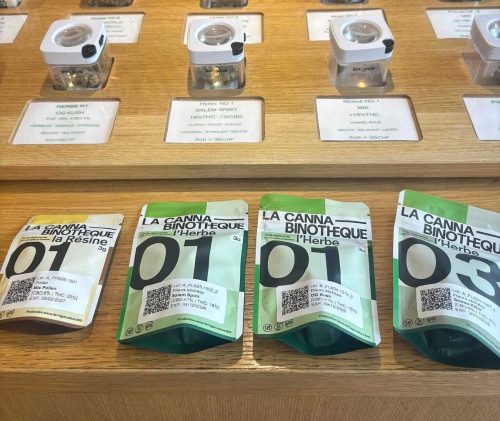
Switzerland has one of the most interesting and rapidly evolving cannabis policies in Europe, or indeed the world, including a unique experiment with legal non-medical cannabis regulation models in 7 cities now underway.
Currently, cannabis remains technically illegal in Switzerland. Since 2012 possession of up to 10g has been decriminalised, with offences addressed in a similar fashion to a speeding ticket; a CHF 100 fine (about £90), and no criminal record or court appearance. In many Cantons police have adopted a de-facto non enforcement policy for small scale possession so even the fines are not deployed. Possession of over 10g remains a criminal offence.
Switzerland has also allowed low THC cannabis to be sold in various formulations for 15 years, with these products being available in dedicated cannabis/CBD shops. These low THC products can contain up to 1% THC (a higher level than the 0.3% THC allowed for hemp products in the EU) and are mostly used as CBD-oriented ‘wellness’ products. They can have intoxicating effects if you consume enough or have low tolerance, but these are moderate compared to conventional herbal cannabis used recreationally, that mostly ranges from 10-20% THC in European markets.
Semi-synthetic CBD-derived ‘intoxicating hemp’ products (including HHC, Delta-8 THC, Delta-0 THC etc.) are specifically prohibited as novel psychoactive substances and not available for sale as in some EU countries.
Medical cannabis has been widely available on prescription since August 2022.
More generally Switzerland, despite having a quite socially conservative political culture, has a long history of pragmatic public health thinking in drug policy, notably regarding their policy around opioids, harm reduction and heroin assisted treatment.
Uniquely in Europe, there have also been a series of national referenda cannabis and wider drug reform in Switzerland. These referenda, like ballot initiatives in some US states, can reform or implement new laws, and in Switzerland can be triggered by the gathering of 100,000 signatures.
One such ‘popular initiative’ sought to amend the constitution to legalise cannabis cultivation, possession, and consumption in 2008. Whilst achieving a majority support in urban areas, when more conservative rural populations were included on 36.7% of voters supported the legalization initiative
Further back in 1998 the so-called "DroLeg" initiative called for legalisation and state-regulated markets for all drugs, not just cannabis, but its ambitions proved well ahead of their time and it was rejected with a majority of over 74%.
The new cannabis regulation 'experiment'
There is now a unique set of regulated cannabis market pilot projects running in several cities under the experimental provision added to the Federal Narcotics Act in 2020, and enacted in 2021. The goal, as outlined by the Swiss Federal Office of Public Health, is to increase understanding of the pros and cons of legally regulated cannabis models, and to provide a ‘scientific basis for future legal regulation’. The setup and management of the pilot trials is summarised in this schematic:
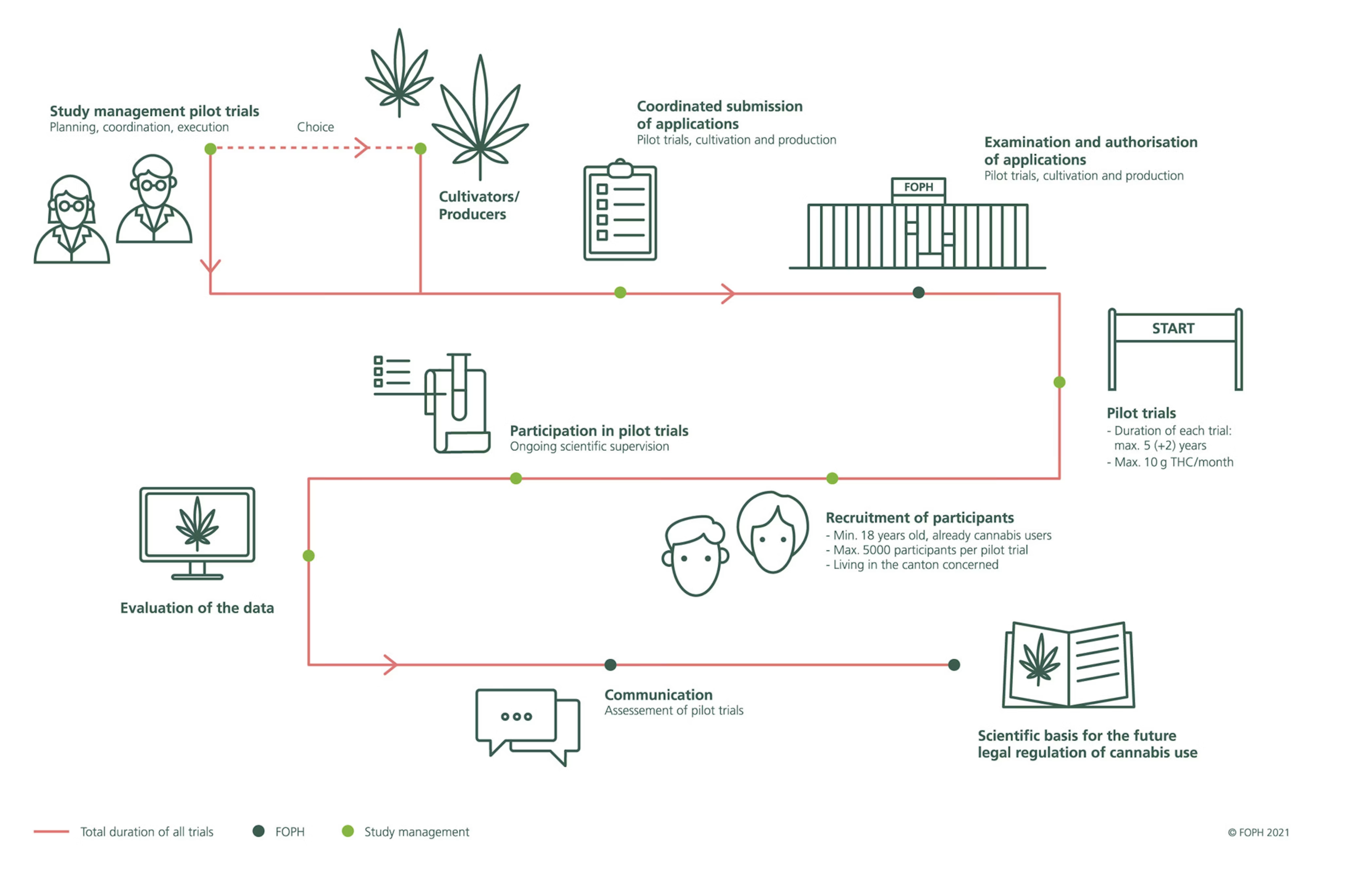
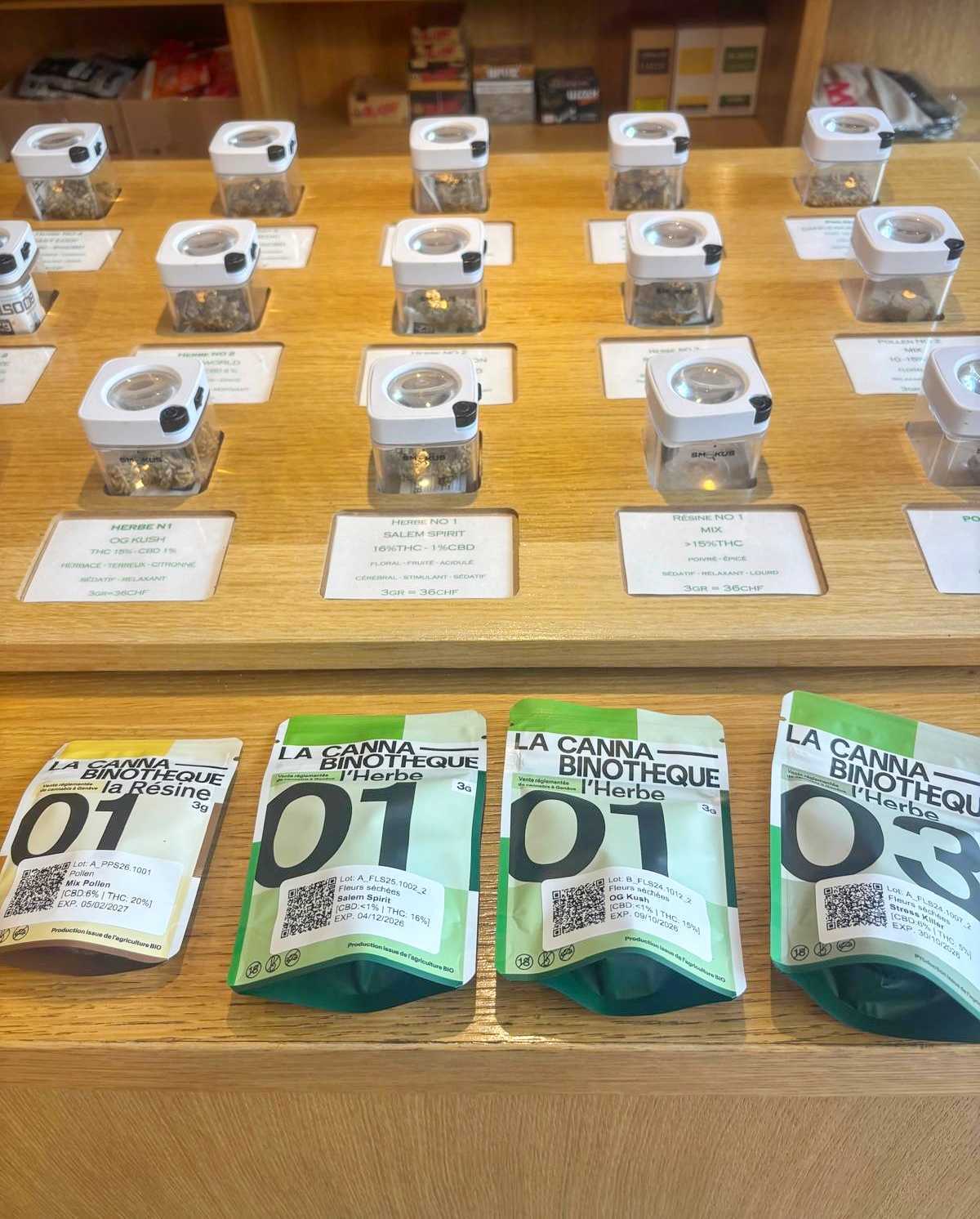
A particularly useful element of the experiment is its variation. The (current) eight trials explore a variety of supply models: pharmacy sales, specialist cannabis shops (both commercial and non-profit) and membership based associations (aka 'cannabis social clubs'), each offering different forms of regulated production and adult access.
A series of government commissioned academic evaluations are now reporting encouraging evidence from the opening phase of these trials. An ‘Analysis of Results from Cannabis Pilot Trials in Swiss Cities – mid-2024 to mid-2025’ published in January reports that roughly 10,400 adults have been enrolled across seven trials (up to July 2025), estimated to be around 5% of Switzerland's 220,000 monthly cannabis consumers.
We will have to wait for the longer term outcomes (the trials are running for 5-7 years) and granular comparisons of outcomes from the different models. However, among the reported outcomes at this early stage:
- Participants report satisfaction with product quality and the advice they receive, and no significant health or public order problems have emerged.
- Some report better mental wellbeing, linked to reduced procurement stress and stigma.
- Most now source cannabis primarily through legal channels, with both commercial and non-profit models drawing users away from the illicit market within a year or two
- Average monthly THC purchases have stayed broadly stable over participants' first year so despite nominally easier access to cannabis, consumption is not increasing
- Whilst stronger herbal cannabis remains the most common preference there is a trend towards lower-risk consumption, suggesting that targeted health information can promote lower-risk products/behaviours (vapes, edibles and products with low THC content).
- Indications that even the non-profit models ‘without commercial incentive strategies and with a controlled, health-oriented strategy are successful in combating a measurable part of the illegal market’.
One of the pilots, Basel WeedCare has taken the form of a randomised control trial, with initial findings published in the peer reviewed journal Addiction. In this study ‘participants were randomly assigned to the intervention group with public health-oriented recreational cannabis access in pharmacies (regulated cannabis products, safer use information, voluntary counseling, no advertisement) or the illegal market control group (continued illicit cannabis sourcing)’.
The key conclusion is that ‘Public health-oriented recreational cannabis access may decrease cannabis use and cannabis-related harms, especially among those using other drugs.’
There is of-course a lot we do not yet know. Criminal justice data for example, in terms of reduced engagement of people who consume (or indeed grow and sell) cannabis , is not yet available. The experiment also only recruits existing users so will not provide much useful insight into recruitment of new users, particularly amongst young people. Impacts on prevalence of use focus on consumption from legal versus illegal sources - not wider population prevalence.
How to make good policy?
We will have to wait for the final conclusions of the Swiss experiment in a few years time. What we can say with confidence at this stage is that the Swiss are developing their policy in a cautious, responsible, and evidence-based way, that prioritises public health, community safety and youth protection. Evidence so far seems very promising.
Some may argue that the experiment is merely a way to finesse the restrictions of international law both EU and UN (see below), and 'legalise by stealth'. There may be some truth in this. International legal barriers have long shaped reform processes. The German nonprofit membership-based association model was significantly shaped by EU and UN restrictions, and the peculiarities of the much older Dutch coffee shop system, similarly.
However, if the Swiss experiment continues to provide a wealth of robust data on the impacts (whether positive or negative) of different regulation models that can inform future policy development in Switzerland and beyond, we should perhaps not grumble about the reasons why the experiment has taken on this particular form. It means that policy will be driven by evidence and public health priorities under the auspices of responsible state agencies and academic institutions. This offers a stark contrast with some of the more commercially oriented models in the US that have been shaped much more by the industry funding supporting interests of corporate profits.
The experiments are also informing parallel legislative efforts at a Federal level to pass a more comprehensive cannabis regulation policy into law. The proposed legislation in the draft bill is notable because it is built around public health and harm reduction, seeking a non-commercial framework, very much in line with Transform's proposals. Details of this bill will be explored in a future blog - but you can read a review of the draft legislation by a group of international policy experts, here.
What is the legal status of the trials under international law
The pilot experiments now underway in Switzerland occupy a somewhat ambiguous status under International law. Whilst the commercial sales of cannabis for non-medical use are clearly prohibited under the UN drug treaties, Switzerland has argued that as ‘scientific experiments’ approved and licensed under domestic law, subject to geographical and time limitations and rigorous academic evaluations, they constitute scientific research and are therefore permissible within the UN treaty carve-outs for ‘scientific and medical’ uses. The legal validity of this argument is somewhat murky - it has yet to be tested. Notably however the International Narcotics Control Board that overseas implementation of the treaties and acts in some ways as their watchdog, has not suggested that the experiments are in breach of the treaties, In the same way that they have, by contrast, condemned the commercial retail markets established in Uruguay and Canada.
Switzerland is not an EU member state, but is deeply integrated into the bloc's single market through a complex network of over 140 bilateral treaties. The country also participates in the Schengen Area and the European Free Trade Association, enjoying free movement of people but without members in the EU parliament or voting rights on EU regulations it adopts. The status of cannabis legalisation with the in the EU is also somewhat ambiguous. A number of countries, including Luxembourg, Germany, Malta, and Czechia have legalised home growing for personal use. Germany and Malta have additionally put in place framework for licensed and regulated membership based associations that can grow and supply members on a not-for-profit basis. These European reforms are exploiting the flexibility under EU law to adopt non-criminal sanctions for personal cannabis use, with the German and Maltese association models proposed as a form of collective decriminalisation that nominally does not breach the EU restrictions on commercial retail markets. As part of the Schengen area Switzerland is bound by specific EU restrictions despite it's only part-integration with EU law.
The Netherlands is also pursuing a pilot 'scientific experiment' with regulated production and supply to a selection of its famous cannabis 'coffee shops'. These formally tolerated cannabis outlets have historically being supplied by the illegal market in what is sometimes being described as the ‘Dutch paradox’ (a legal front door and an illegal back door). While the EU has not formally approved either the Netherlands or Swiss cannabis experiments they have been reviewed to establish whether or not they breach Schengen rules, or UN treaty obligations (which EU member states are bound by as a condition of membership). Despite the ambiguities evident in international law, it appears that the potential breaches were not deemed too significant to allow the experiments to proceed. Germany, Luxembourg and Czechia have all proposed similar experiments with commercial retail models.
What happens after the experiment elapses remains a moot point, particularly if, as expected, the experiments prove broadly successful on key indicators. They could be extended for more years or to cover more territory. They could potentially even be extended nationally so effectively establishing a national policy that just happens to be called a 'scientific experiment'. A more likely outcome is that during the period of the experiments EU and or UN law will evolve to allow flexibility for member states to explore alternatives of prohibition. This outcome becomes increasingly likely as more and more member states defect from the failings of the International drug control regime.
For a deep dive into issues relating to domestic cannabis reforms and EU/UN law see the seminar briefing from TNI, WOLA and GDPO; 'Cannabis Regulation, EU Drug Law, Trade Rules, and the UN Drug Control Treaties Summary Report of the Expert Seminar: 17–18 June 2024, Amsterdam' (in which Transform was a participant)
On this basis it would appear the UK could implement a similar domestic-only experiment to those in Switzerland without risking tensions with the EU or UN treaty commitments. The UK is, of course, no longer bound by the EU rules on cannabis regulation due to Brexit (at last - a tangible benefit?), unless a decision is made to rejoin 9which whilst perhaps likely at some point, is still some years off). When the UK Government does decide to finally do the right thing and legally regulate cannabis, such an experiment could well provide the basis for how to get it right. In the mean time there is, once again, much to learn from Swiss public health pragmatism.