26th June 2026
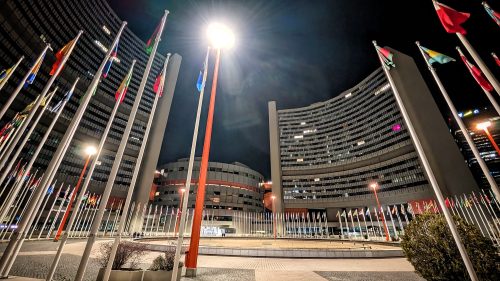
Four takeaways from this year’s World Drug Report
As always, there is a lot of ground covered in 100s of pages of the 2026 World Drug Report (WDR). There will be opportunities to dig into some of the more granular detail in the coming weeks, but here are a few initial takeaways
1. Overwhelmingly grim outcomes of the war on drugs
For an international policy framework with the express goal of protecting the ‘health and welfare of [hu]mankind’ and creating a ‘drug free world’, as well as the broader UN goals ensuring peace, security and the protection of human rights - The World Drug report makes clear once again, in an often brutal and unrelentingly dismal account, that the global drug control system the UNODC oversees is a staggering generational failure.
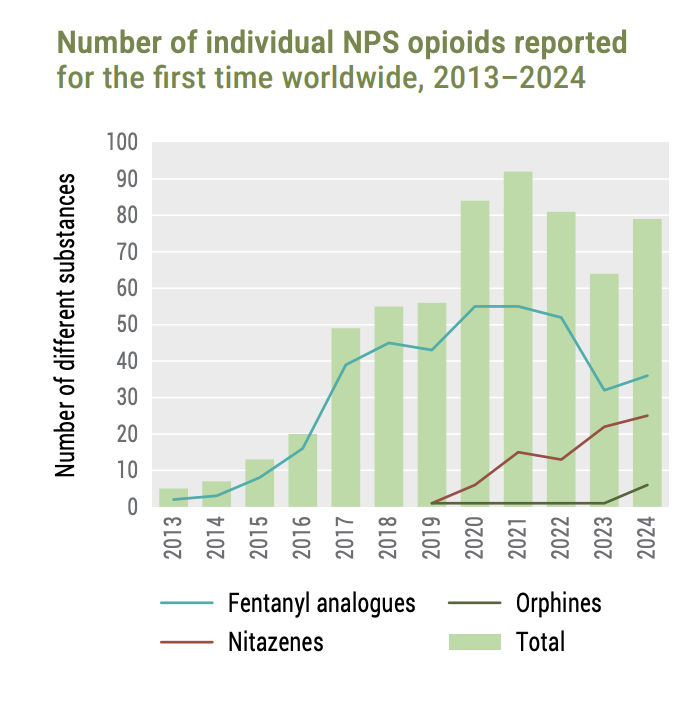
Drug production is increasing and drugs are more available than ever before thanks to new technologies; Drug markets are diversifying into an ever expanding zoo of synthetic compounds, including deadly super-potent opioids; more people are using drugs; injecting drug use is rising; drug related deaths are rising; drug services are woefully inadequate globally, particularly for women, and drug market related violence and insecurity is intensifying.
A few key stats to set the scene:
- An estimated (and likely conservative) 331 million people used an illegal drugs in 2024, a 34% increase in 10 years
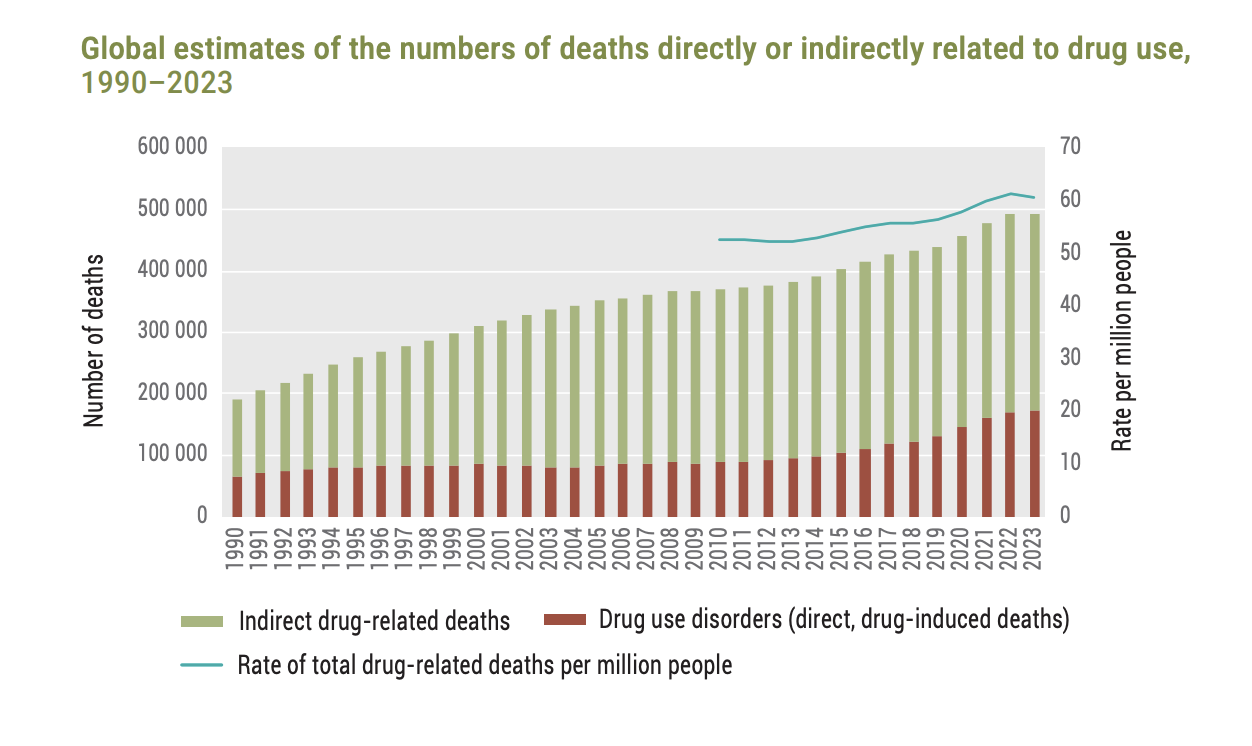
- There were 492,000 drug-related deaths in 2023 at the global level, 29% higher than a 10 years ago
- Cocaine production has more than quadrupled in a decade from 1000 tonnes in 2014 to over 4000 tonnes in 2024
In technical terms; it's a complete shit show.
They don’t even attempt to take credit for the few morsels of more positive news - like decreasing youth use of some illegal drugs in some regions (where alcohol and tobacco use is also falling). And even the superficially ‘positive’ enforcement/process outcome, like increasing drug seizures, simply veneer over darker truths revealed elsewhere, that rising seizures are in fact measures of failure, reflecting expanding markets rather than some triumph of the 'war on drugs'.
2. Even this comprehensive chronicle of misery omits key elements of the story
Astonishingly, there is nothing in the report about human rights. The words ‘human rights’ do not appear once in the main document. For a report from a UN agency that, like all UN bodies, is supposed to centre human rights in all its work, this is an outrageous oversight, but one has to assume - a deliberate one.
This is an especially egregious omission given the catastrophic human rights implications of drug law enforcement and illegal drug markets globally - chronicled in detail by the Office of the High Commissioner for Human Rights in a series of high profile reports, and in a presentation delivered by the High Commissioner at the UN Commission on Narcotic Drugs in 2024. The World Drug Report has previously included a special thematic briefing on the right to health, albeit an inadequate one - but despite more than 40 member states requesting the UNODC include systematic reporting on human rights annually in a dedicated section of the world drug report, this has not happened. It is perhaps not hard to understand why there would be a lack of enthusiasm for this form of scrutiny given the horrors tand abuses the global drug control regime is helping perpetuate. It is important to note that, by contrast, a group of UN special rapporteurs today released a statement noting that 'the human and environmental costs of the “war on drugs” is staggering' and making a case for human rights led reforms. The UNODC is unique amongst UN agencies in its almost total decoupling from UN human rights focus, language, mechanisms and norms.
Also remarkable is the total absence of any reference to harm reduction - A key pillar of the global drug response and a policy for which UNODC has a key international role. Given the reports account of increasing drug related harms and the particular threat from synthetic opioids a new other new NPS the omission of any description, or analysis of evidence based interventions that can reduce harms these emerging markets are fuelling is bizarre, inexplicable, and negligent.
Also absent is any account of the environmental implications of the drug control system. As with human rights, there have been occasional thematic briefings/chapters with the WDR on the intersection of drug policy and environmental sustainability in recent years. Given the urgency of a challenges those reports highlighted it is deeply troubling that there is no follow-up, no updates, no data - Not even a passing mention of this profoundly important, existential challenge.
Even the Sustainable Development Goal framework receives no mention whatsoever. Despite being a core pillar of all UN agency work guiding outcome evaluation, and a framework signed up to by all member states at the General Assembly. The UNDP produced a detailed discussion document exploring the development dimensions of drug policy last year (the latest in a series of three going back to 2016) - but, like the contributions from the UN human rights mechanisms, this work is not mentioned or referenced. It is hard to see the decision to excise the SDGs from the UNODCs flagship publication has not been driven by pressure from a belligerent and ideologically unmoored US administration.
Civil society has often attempted to fill the yawning gaps in the UNODC evaluation of the global drug control regime. This work includes transform's 'Alternative world drug report' (somewhat out of date now, being published back in 2016 - but still a useful reference) and the more recent report from IDPC 'The UNGASS decade in review: Gaps, achievements and paths for reform'.
3. They quietly acknowledge the role of prohibition as a structural driver of violence, instability, and death.
This years’ bolt on thematic briefing in the WDR concerns the ‘impact of drug use on safety and security’. This briefing, whilst not great, is at least reassuringly non-terrible, given that it was produced with funding from we-hang-people-for-minor-cannabis-offences Singapore. It highlights three core drivers of safety threats and insecurity related to drugs (based on Goldstein’s tripartite conceptual framework); drug use and intoxication itself; crime proximal to drug use such as low level property crime to fund purchase of drugs (largely prohibition related); and, crucially ‘systemic risks and threats associated with the use of drugs in the community’ that are ‘shaped by broader external conditions and the policy decisions and enforcement responses that structure local drug markets’. In other words - the enforcement of the criminalisation of use, and absolute prohibitions on legally regulated availability, as they collide with ever-growing demand.
Elsewhere in the briefing it notes systemic threats to safety include ‘Criminalization of drug use, systemic marginalization, violence’ and ‘Propping up illegal markets that contribute to violence and corruption’. They note, in passing at least, how criminalisation increases drug related risks, butstill don't repeat established calls for decriminalisation.
Again, to note: human rights receive no mention. Nothing on indigenous rights. Nothing on the death penalty (that Singapore so grotesquely champions). Not even a passing mention of the right to health.
In contrast the group of UN human rights special rapporteurs statement, also published today, not only notes that:
“Evidence consistently shows that militarised and punitive approaches fail to reduce drug markets, instead driving displacement, adaptation, and escalating violence while leaving underlying economic incentives intact. Prohibition fuels illicit profits, strengthen organized crime, and increase risks through unsafe supply.”
But also;
“By addressing the root causes of drug use, poverty, trauma, social exclusion, and structural inequality. Rather than criminalising those who suffer the consequences, the international community can build drug policies that genuinely protect and promote the health, dignity, and rights of all.”
4. There’s very little on meaningful solutions to the problems they describe
There is lots of detail on drug harms - but, as already noted, almost nothing on drug harm reduction.
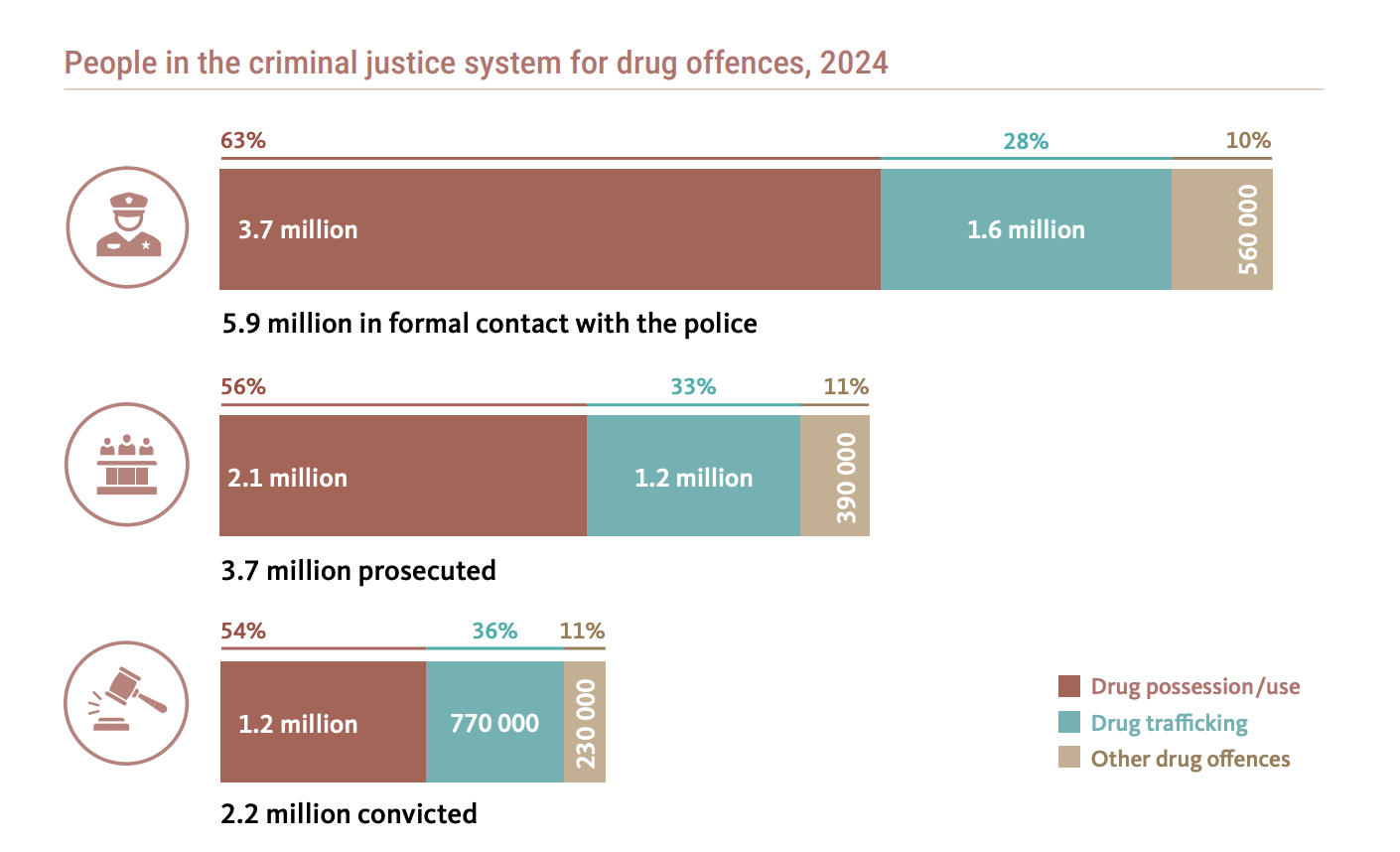
There’s a surprisingly detailed description of impacts of enforcement and criminal justice disposals, that notes the widespread adoption of non criminal sanctions for minor drugs offences - even if it cant bring itself to describe this as decriminalisation like every other UN agency (and everyone else on the planet) has long done. It notes that there are nearly 6 million formal contacts with enforcement for drug offences (3.7 million for possession), leading to 2.2 million convictions (1.2 million for possession). This compares to 1.7 million convictions reported for 2022 - so an increase of half a million in just 2 years.
The WDR does usefully note that ‘looking specifically at the use of drugs, more than half of the reporting countries in the Americas and Europe do not criminalize such behaviour’. But there is nothing on the benefits of decriminalisation, or what decriminalisation best practice looks like, no mention of the recent UNAIDS guidance note on decriminalisation (even though UNODC share joint responsibility for the HIV response with WHO and, for a little longer at least, UNAIDS), and no mention of the UN system common position statement on drugs. This statement, agreed by all 31 UN agencies including UNODC, makes a clear call in its ‘directions for action’ for the UN ‘to promote alternatives to conviction and punishment in appropriate cases, including the decriminalization of drug possession for personal use’. The WDR - once again - fails to do this in any way, shape or form (and unmentioned in the report is the UNODC prison building programme.)
The UN system common position also calls for the UN to ‘promote harm reduction’ (the WDR doesn’t even include the words), and ‘to support the implementation of all Sustainable Development Goals’ (which, as noted, also go unmentioned).
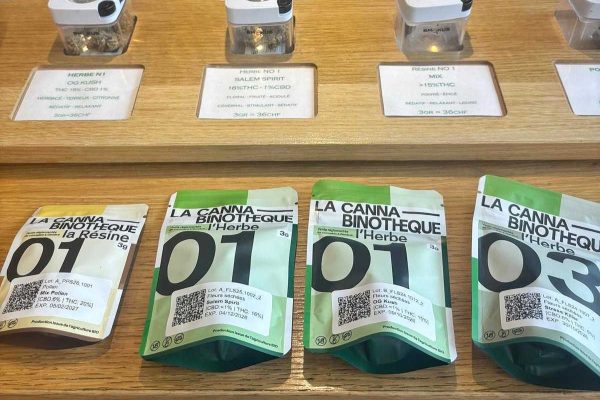
There is, however, a reasonably comprehensive section on cannabis reforms around the world - but it is mostly descriptive rather than analytical. Interestingly it does not specifically condemn moves towards legalisation and regulation - despite the fact that such moves challenge the letter or spirit of the prohibitionist drug control treaty regime the UNODC oversees. This perhaps reflects and acknowledgement that so many member states and jurisdictions have now legalised that International norms are shifting, even if archaic treaty law has yet to catch up. Given that there are now more than 500 million people living in jurisdictions, now on every continent, implementing some form of regulated access to non-medical cannabis for adults you might hope the UNODC might offer some guidance on best practice to ensure the reforms deliver on UN goals - sadly, nothing is forthcoming.
For more analysis from of the WDR from IDPC see: Documenting failure, avoiding solutions: Reflections on the World Drug Report 2026