15th October 2026
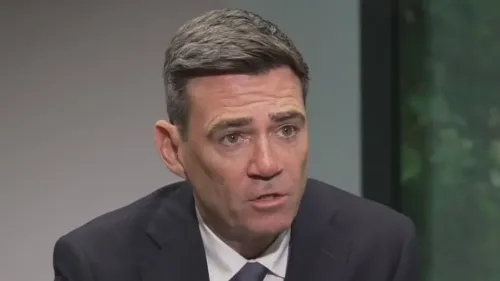
Andy Burnham has made his first public statement as Prime Minister on drug decriminalisation (ending criminal sanctions for possession of drugs for personal use), saying that he does not support it. The statement seems at odds with his previous support for drug diversion schemes as Mayor of Greater Manchester, his support for the Psychoactive Substance Act (which in effect applies a no-sanction model for drug possession) as an MP in 2016, and his commitment to support young people, homeless people and the socially and economically marginalised more broadly, who carry the greatest burden of criminalisation.
As his first statement on drugs policy as Prime Minister, it’s worth interrogating more closely.
The comment was made in the context of a pre-Labour-conference BBC Scotland News interview (watch the short segment here). He was questioned about Scotland's First Minister John Swinney's recent advocacy for decriminalisation as part of the response to Scotland’s drug death crisis.(1)
Some key takeaways from this.
1. Burnham avoids weaponising the issue to score political points
Burnham has, so far, made efforts to avoid the more gladiatorial and partisan aspects of Westminster politics, notably avoiding attacks on opponents in his inaugural conference speech. This moderation is evident in his comment disagreeing with Swinney's decriminalisation position, noting his respect for him and that he will hold his view for ‘good reasons’. This, at least, is welcome, and certainly marks a stark contrast with the Gorton and Denton by-election where the Labour Party aggressively (albeit very unsuccessfully) attempted to weaponise the issue of drug policy in their attacks on the rival Green Party candidate.
Timing may also be a factor here. Burnham was asked this question days before his first big party conference speech, and may not have wanted to open a potentially fraught national debate on polarising and complex issues (both drug policy and Holyrood/Westminster tensions) which could overshadow his key conference messages around social care, nationalisation, Brexit, and voting reform. We know already that he is not beyond adapting positions as political contexts shift (note his different positions on rejoining the EU in the Makerfield by-election, and the conference speech).
2. His rejection of decriminalisation of possession is at odds with previous support for approaches that avoid criminalising possession.
In the recent past Burnham supported drug diversion programmes in Greater Manchester. While technically not decriminalisation (since possession remains a criminal offence), diversion shares core principles (criminalisation of possession is costly and criminal records are harmful) and outcomes (avoiding the harms of a criminal record) with the decriminalisation policy Burnham is now rejecting.
In ‘Standing Together: Our plan for policing and safer and stronger communities in Greater Manchester 2024-2029’ Burnham’s foreword, written as Mayor, notes that
‘Too many young people encounter the criminal justice system, and we need an approach that recognises their youth and meaningfully diverts them away from that system wherever possible.’
Within the plan are recommendations to:
‘Focus our law enforcement, court orders, and treatment interventions on the small minority whose drug use is associated with criminal or anti-social behaviour.’
And to:
‘Work with GMP [Greater Manchester Police] to develop a new approach to those arrested for drug possession that enables police and prosecutors to apply a proportionate response to users who do not directly harm others, dependent users, and those profiting from drug supply.’
This recommendation is expanded on in a 2025 GMP progress report on the drug strategy from deputy Mayor Kate Green:
“The GMP Drug Strategy commits to working with GMCA to explore a pre and post arrest diversion scheme for possession of illegal drug offences in appropriate circumstances and increasing the use of Out of Court Disposals (OoCDs) for drug possession offences.
A GMP review is due for completion in Autumn 2025 that will consider options for piloting a drug specific diversion scheme as an alternative to prosecution. We are also developing our current understanding of OoCDs given for possession of drug offences.”
It is therefore strange that he says in the BBC interview ‘I looked at these issues when I was Mayor of Manchester and I couldn’t support them then’, when he did in fact look at diversion (which is at least ‘decrim-adjacent’, or ‘decrim-lite’, or ‘halfway-house decrim’ if you prefer) and he did support it. And as Mayor, Burnham, like Swinney, did not have the power to change laws on possession (which is a power held in Westminster), only how they are enforced.
When Burnham was previously an MP, he also voted in favour of the Psychoactive Substances Act (PSA), which passed into law in 2016. This drug control legislation operates in parallel with the Misuse of Drugs Act (MDA) 1971 (which prohibits cocaine, heroin, LSD, cannabis, MDMA etc.). It nominally complements the MDA controls by default prohibiting any ‘psychoactive’ drug not specifically controlled under the MDA by name. It was designed to control the growing market in so-called ‘legal highs’, new drugs that had yet to be included in the MDA. But, crucially, the PSA 2016 does not criminalise possession of drugs within its ambit for personal use (except for possession in prison). It is, in effect, a no-sanction decriminalisation model (although a decriminalisation process is not needed, as possession was never criminalised in the first place). The reason possession of drugs was not criminalised under the PSA was thanks to wide ranging-expert advocacy that criminalising possession is an ineffective deterrent, but creates harms that fall disproportionately on vulnerable people. This is also true under the MDA, which criminalises possession, an extraordinary and untenable contradiction between the parallel legislative tools at the heart of UK drugs policy, and one that Burnham seems to have not yet considered, or worse, is unconcerned by.
3. Criminal sanctions don’t send out messages on harm. They are harm
To justify his rejection of decriminalisation Burnham makes the argument that: ‘I don’t think we should send a confusing message to young people, I think we should be clear about the harm of drugs’.
The obvious problem with this statement is there’s no evidence that criminal status is a useful way to educate young people, or indeed any people, about drug-related risks. There’s also no compelling evidence that criminalising or decriminalising a drug, or increasing or decreasing criminal sanctions for possession offences, significantly impacts on its prevalence (even while it does impact on overall harm). Often the opposite has happened. Ketamine use, as a current example, more than doubled in the years following its prohibition as a class C drug in 2006, and more than doubled again after criminal penalties were increased and it was made class B in 2014.
Impacts of user-level punitive enforcement on prevalence are, at best, marginal. Drug use decisions are predominantly driven by social, economic, and cultural variables - not the harshness of punishments, or what is said by ministers at the dispatch box.
If we want to educate young people about drug risks, and encourage responsible and informed choices, we should use established public health education tools that we know can actually work. We do not criminalise other risk behaviours like unsafe sex or unhealthy eating, we educate, and it works. The same is true with legal drugs like cigarettes, use of which has been falling consistently among young people for three decades.
But while we know that criminalisation is singly ineffective at educating young people about drug-related harms, we also know that criminalisation is itself a public health harm. The stigma of a criminal record negatively impacts on life prospects: the ability to find a job, find housing, and maintain positive family and community relationships - all of which are known protective factors regarding problematic drug use and engagement in crime. At the same time, the threat of criminalisation fosters distrust in drug services and official messaging on drug risks; why would young people listen to official drug information, from the same people trying to arrest and punish them? And criminalisation diverts limited drug policy resources away from proven prevention, harm reduction and treatment interventions, and towards counter-productive and harmful punitive enforcement.
4. Burnham’s advocacy for criminalisation of vulnerability is at odds with his position on protecting the vulnerable
It is important to be clear that if you don't support decriminalisation - you are supporting criminalisation. That means you are supporting the arrest, punishment, criminal records, and even potential incarceration, for around 33% of the adult population, or 18 million people, who are using, or have used a drug prohibited under the MDA (including Andy Burnham).
And if you advocate for mass criminalisation, you are implicitly willing to tolerate the vast cost burden that the enforcement of this policy places on the criminal justice system. And we know that the greatest burden of criminalisation harms is carried by the most socially and economically marginalised individuals and communities; poor people, young people, people from racialised minorities, and people living with drug dependence and homelessness. It is a reality that makes Burnham’s rejection of decriminalisation all the more untenable and misaligned with his wider social justice narrative. His USP has always been fighting for the marginalised - but here he is advocating a failed policy that overwhelmingly impacts on them. Punitive drug enforcement is a key vector of social injustice, and one that incurs vast opportunity costs health and social programmes, from the billions such punishments cost to administer each year.
We hope Andy Burnham and his advisers and government will revisit this issue in the coming months, and reconsider both the evidence for reform, and the moral and political implications of advocating arbitrary mass criminalisation of vulnerable populations. It is about as far from social justice as it is possible to be.
However, It is only a small step from 'diversion', as a way to avoid harmful criminal sanctions for possession, to actually removing harmful criminal sanctions for possession offences altogether, aka ‘decriminalisation’. What its called is not really important - the outcomes are. Diversion is already endorsed by Burnham himself, by the current and previous Conservative governments, and Dame Carol Black, the government’s recently re-appointed independent adviser on drugs. Diversion is rapidly being adopted as best practice across UK police authorities, albeit led by police rather than government. This is not a huge or radical step - government just has to make the same arguments for decriminalisation; criminalisation is harmful and ineffective, and health-led policy will deliver better health outcomes, CJS outcomes, and value for money.
There is a range of policy and practice that comes under the banner of ‘decriminalisation’, and it’s important to be completely clear what we are talking about - not least when the term is frequently conflated or confused with legalisation/regulation. It’s important when the change does happen, to get it right; the goal should be what IDPC have referred to as the ‘gold standard’ for decriminalisation.
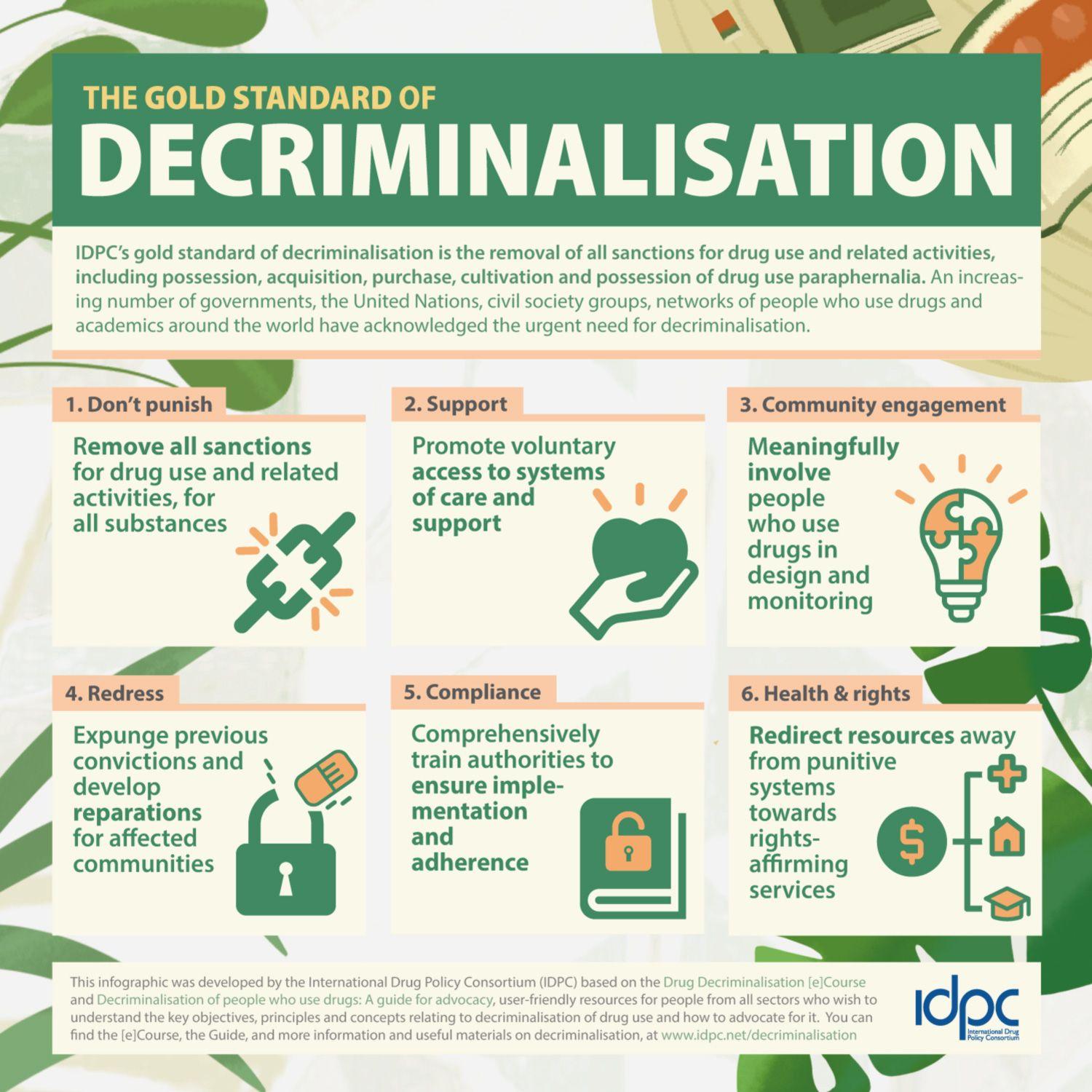
And when the government does decide to make the move, they will already have significant public, institutional and expert backing to do so. The Government’s appointed experts, the Advisory Council on the Misuse of Drugs, have long called for non-criminal sanctions for possession offences (specifically highlighting the inconsistency between the MDA 1971 and PSA 2016). The Royal Society for Public Health, The Royal College of Physicians, and the Faculty of Public Health have all actively advocated for decriminalisation for years. Decriminalisation was recommended by the Scottish Affairs Select Committee, and the Health and Social Care Select Committee in 2019. Decriminalisation has also long been the editorial position of the UK's leading medical journals, The Lancet and the BMJ. Internationally the WHO, the UN Office of the High Commissioner for Human Rights, the UN Office on Drugs and Crime, UNAIDS, UNICEF - indeed the entire UN agency ecosystem has unambiguously called on member states to implement decriminalisation since 2018. More than 30 jurisdictions around the world have implemented the reform for some or all drugs. Any political anxieties about this move feel very misplaced.
We encourage Andy Burnham to engage with the evidence, the people most impacted by criminalisation, and the growing number of police forces supporting moves away from punitive enforcement models, to explore how a public health-led approach can reduce harm and build safer communities. Transform and colleagues across the drugs field stand willing to offer our support on policy design and implementation for the new Prime Minister and his Government when he commits to delivering this modest but long overdue reform.
Footnote:
1) Swinney has advocated for decriminalisation before, and it has been the SNP position since 2023, featuring in the 2024 manifesto, (and in 2019 and 2021 manifestos, framed in terms of establishing processes with Westminster to allow it). As so often, Holyrood/Westminster power politics casts a shadow over the debate. Westminster retains control over drug laws, so the Scottish Government cannot unilaterally implement de jure decriminalization, much to the SNP’s chagrin. Scotland has already implemented what they refer to as a ‘drug diversion’ scheme - which, as noted above, is an important step towards decriminalisation. Under the scheme police have discretion to issue a Recorded Police Warning, rather than prosecution, but as the RPW can show up as an offence on enhanced background checks - it remains, in effect, a criminal record, so even the term de facto decriminalization can’t really be used. This is not the case everywhere: Diversion schemes in different police authorities operate differently.