27th October 2026

A resilient and expanding global, European, and UK cocaine market
What was once seen as a more exclusive and glamorous drug has, since the 1990s, increasingly penetrated a much wider set of demographics and social environments. UK data, for example, highlights that cocaine use in 2000 was twice as prevalent in London as elsewhere in the UK, but rates had equalised a decade later.
Gathering data on illegal drug consumption remains methodologically challenging and something of an imprecise science - particularly when compiling regional data and/or making international comparisons. This is more problematic for the UK since we withdrew from the EU drug monitoring frameworks post-Brexit. However, historic data compiled by the EU Drug Agency (EUDA, formerly EMCDDA) from two key sources, urban wastewater analysis, and national consumer surveys, shows how cocaine’s popularity has surged in the EU over the past two decades, even in the face of the vast and growing resources directed towards user-level enforcement and supply side interdiction.
The rise in cocaine use is driven by a complex mix of supply and demand factors. Increasing availability has been a consistent pattern in this evolving market, including for vulnerable youth populations. The European Union’s 2024 ESPAD school survey observed that cocaine was now ‘easily obtainable’ for 13% of the 15-16 year-old students, higher than for any drug except cannabis. In England 11% of 15 year-olds reported having been offered cocaine in a 2024 NHS survey of young people's behaviours.
The emergence of dark web mail-order sales and crypto-currencies, alongside new encrypted messaging app-driven delivery services, has created convenient and accessible new retail supply models able to evade almost all traditional user-level enforcement. The stereotype of the sinister drug dealer lurking on street corners or outside school gates is even less true today than it has ever been. Cocaine is now readily available, with fewer obstacles, for anyone who wants it. One 2018 consumer survey found cocaine orders in the UK were delivered faster than a pizza.
Rising availability of cocaine has come hand in hand with falling price, and rising purity - the precise opposite of the outcomes sought by supply side enforcement. Between around 2005 and 2012, insurgent Balkan-based OCGs staged a remarkable takeover of cocaine markets in large parts of Europe. Forging direct links with Brazilian and other Latin American OCGs, they vertically integrated the supply chain, cutting out the ‘middle men’, reducing wholesale costs, and increasing their margins.
This savvy business move enabled them to maintain or increase profits at the same time as offering a cheaper, higher purity, and a more reliable quality product to consumers. The result was a rapid displacement of existing supply chains and a market saturated with accessible cocaine - naturally increasing its consumer appeal and feeding into the rising use.
Assessing the value of the UK market from conflicting data sources
The UK Government-published estimates of the size and value of the UK cocaine market are calculated from two key sources; survey data, primarily the Crime Survey of England and Wales (CSEW), and wastewater analysis, where sewage is tested in multiple sites for drug metabolites excreted following drug use. Both come with their own methodological complexities. They also present a challenge for this analysis because the two methodologies produce dramatically different estimates for the size of the UK market.
Methodology 1: prevalence survey data
In 2020 the Home Office published an estimate of the size and value of the UK cocaine market in the Black review evidence pack. This Home Office-commissioned research, led by the independent expert Carol Black, usefully makes the distinction between the powder cocaine and crack cocaine markets, reporting the following estimates (for England and Wales only):
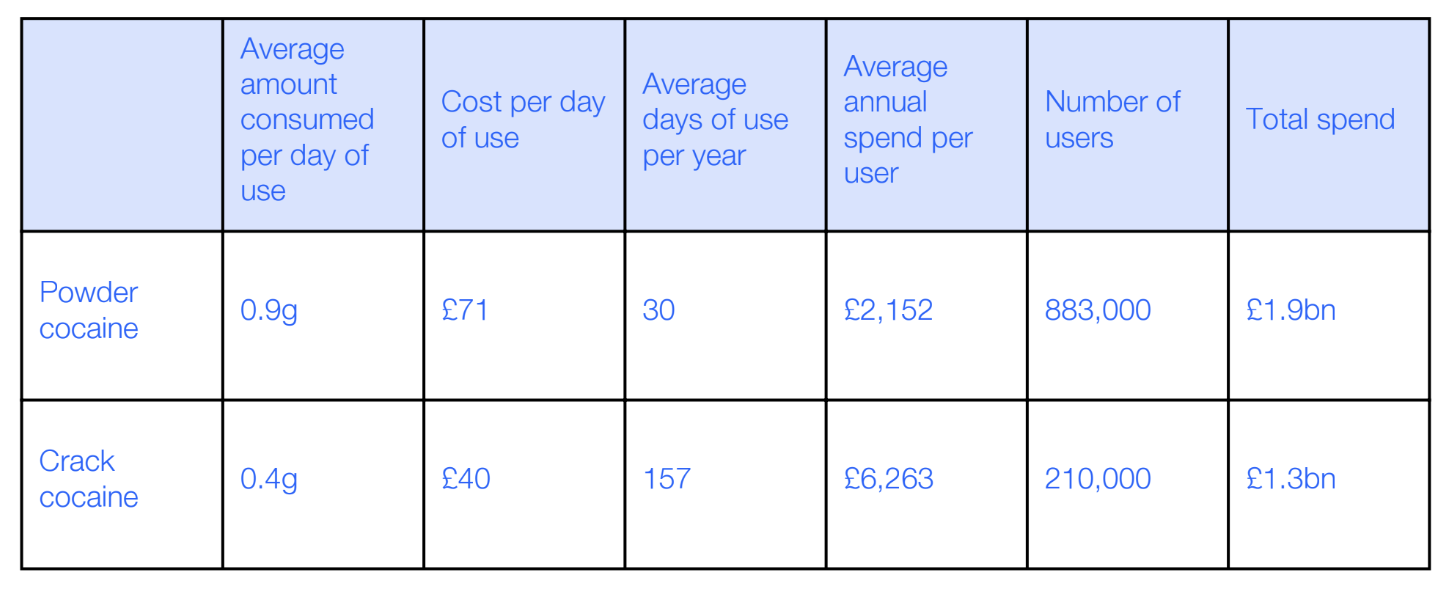
Multiplying the data in this table gives a total volume of powder cocaine consumed in England and Wales of 23.841 tonnes, and crack, 13.188 tonnes - a combined total (assuming weight equivalence between cocaine and crack as reported) of 37 tonnes of cocaine consumed.
However, the data in the Black review is now some years out of date. The evidence pack was published in 2020, using CSEW survey data from 2017. This was augmented by estimates of crack use from separate Public Health England research using data that is similarly now almost a decade old.
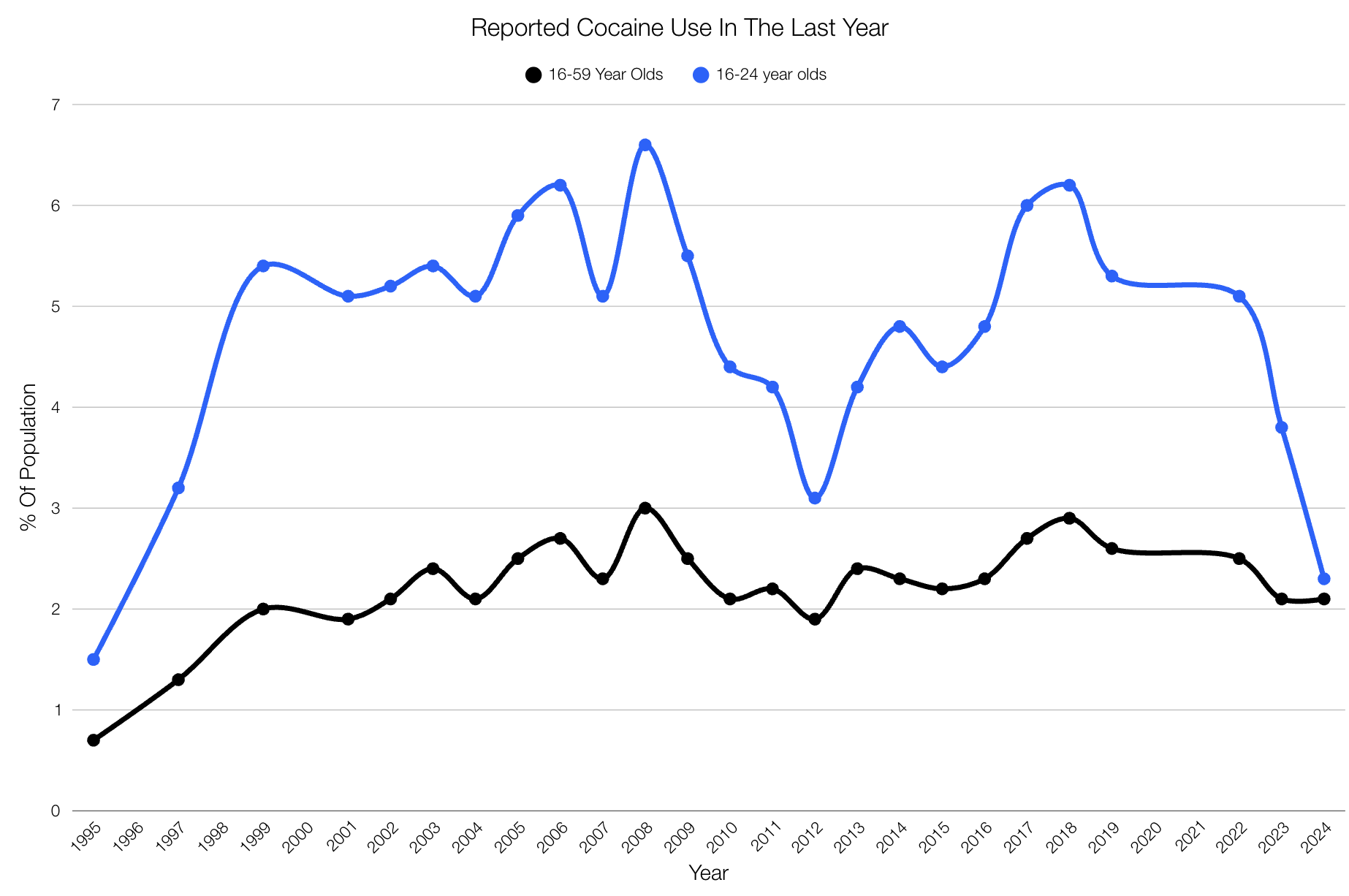
Data from the Crime Survey for England and Wales (CSEW), suggests that after a rapid rise in cocaine use in the late 1990s, prevalence of past-year reported cocaine powder use has stayed fairly constant over the last 25 years, albeit with some fluctuations, particularly amongst young people (see Figure 2). More recent data gathering and trend analysis has been severely disrupted by the COVID pandemic. COVID also directly impacted on patterns of use, with most social settings where cocaine is consumed closing for an extended lockdown period. Use amongst young people was impacted not only by lockdown and related market disruptions, but also by growing cost of living issues that may have displaced use towards other cheaper drugs, notably ketamine, which is between 3 and 10 times cheaper per gram than cocaine. CSEW data suggests ketamine use has risen during the period in which cocaine use has been falling amongst young people. But based on the CSEW alone (albeit potentially contradicted by the wastewater data) it would appear that last-year cocaine powder use prevalence has remained relatively stable, in fact falling marginally since the 2017 data point reported in the Black review.
CSEW survey data on drug use is, however, generally acknowledged to be an underestimate of total use, for two key reasons. Firstly, as the CSEW notes, an ‘unknown proportion of respondents may not report their behaviour honestly’ to official surveys about what remain serious criminal offences (cocaine possession is subject to a maximum penalty of seven years in prison, an unlimited fine, or both).
Secondly, the fact that the CSEW is a household survey means that it ‘does not include populations living in group residences (for example, care homes or student halls of residence), other institutions, such as prisons, or homeless people’, many of whom are known to have higher levels of drug use than the general population. The Black Review, for example, noted that 87% of powder cocaine revenue comes from the 11% who use three or more times per week, the population most likely to be homeless, itinerant, prison-cycling, or otherwise outside the household sampling frame. This skew is even more marked regarding crack use - which is asked about separately in the CSEW, but the results of which are assumed to be even less reliable.
Unfortunately there is relatively little analysis attempting to quantify this undercount, and neither the Home Office, nor the ONS, provides any. However, a 2021 study, published in Addiction, compared CSEW data with a parallel data set from the ALSPAC (Avon Longitudinal Study of Parents and Children) study. This was a longitudinal study that recruited survey participants from birth, meaning they have long-established, more trusting relationships with researchers, thought to produce more honest disclosure than an ‘official’ government survey like the CSEW, administered door-to-door by unknown researchers. This study suggested that for cocaine there was a 4-fold difference (for 24 year-olds in 2017); 4.8% past year prevalence of cocaine use according to the CSEW, compared to 19.6% for the ALSPAC sample. This was an even higher proportionate difference than for past year prevalence for all illegal drugs, which was 16.4% in the CSEW, compared with 36.7% in ALSPAC. The authors do, however, caution that drug use in the ALSPAC study area of Bristol may not be representative of the UK generally, and recent wastewater analysis suggest Bristol has a high level of use in the national context.
The government has also produced estimates for numbers of people who use crack cocaine, the most recent being for 2022-23 but only covers England. This estimate of 170-175,000 can be extrapolated to the whole UK, for a total of somewhere between 190,000 and 210,000. There have been more recent anecdotal reports from service providers of increasing demand for crack-related treatment services - but there is a paucity of evidence to quantify this. Waste water data may provide an indication but, unlike survey data, does not make a distinction between cocaine powder and crack cocaine. There are, however, strong indications of an increase in cocaine injecting, thought to be facilitated by the rising purity of illegal supplies.
Methodology 2: Wastewater analysis
Wastewater analysis under the WAND (Wastewater Analysis for Narcotics Detection), programme commissioned by the Government from 2021, provides a very contrasting picture to the CSEW data. It found that ‘between August 2024 and July 2025 cocaine had the highest estimated consumption and market value [of the drugs being considered] with around 123,000 kilograms (kg) consumed, equating to a £9.8 billion market value’ for England alone. This figure rises to 146 tonnes, with a market value of £11.6 billion if adjusted proportionately to include Wales, Scotland and N.Ireland. Assuming the Black estimates for the proportions of the market that are powder cocaine and crack cocaine are correct this would translate to around a split of 87 tonnes of powder cocaine and 59 tonnes of crack cocaine being consumed annually.
This is more than three times the Black review estimate of 43.7 tonnes total cocaine and crack consumption, and a market value of just under £3.8 billion (when also adjusted proportionately to include Scotland and Northern Ireland, and with an additional 5% upwards correction to account for the increase in the UK population since 2017).
The WAND analysis also suggests the total amount of cocaine being consumed has increased by around 25% between 2021 and 2025, compared to a marginal fall in prevalence of cocaine use according to the CSEW survey data over the same period.
By its own description, the WAND drug consumption and market-value estimates are ‘based on an experimental and new methodology’. The wastewater analysis is a direct measure of total consumption, and is undoubtedly useful in showing trends by extrapolating findings from the 42 sites where testing takes place in England, covering an impressive 28% of England’s population. There is therefore a reasonable certainty that total consumption has risen by around 25% between 2021 and 2025. Calculations of total consumption and value of the market derived from this baseload metabolite data are, however, based on a series of assumptions about what the data represents, including assumptions about the cocaine consumption to excretion rate of the metabolites measured. Relatively small errors in these assumptions can potentially multiply and translate into significant variations in final estimates.
Some of the increase in total consumption revealed in the wastewater analysis over the past 4 years may also be accounted for by rises in purity of cocaine rather than a rise in amount consumed, or total market value. The UK government no longer routinely publishes annual trend data on cocaine price and purity. Purity data was previously reported in the annual Focal Point reports to EU reporting mechanisms - the last one being in 2019, with 2018 data, which reported mean cocaine purity had risen from 20% in 2009 to 63% in 2018. This data can only come from separate surveys, test purchases and forensic analysis of seizures, as no data on price and purity is provided by either CSEW or waste water analysis. The National crime agency now only reports (somewhat inconsistently) whether purity has increased, decreased, or remained stable in its annual strategic assessments.
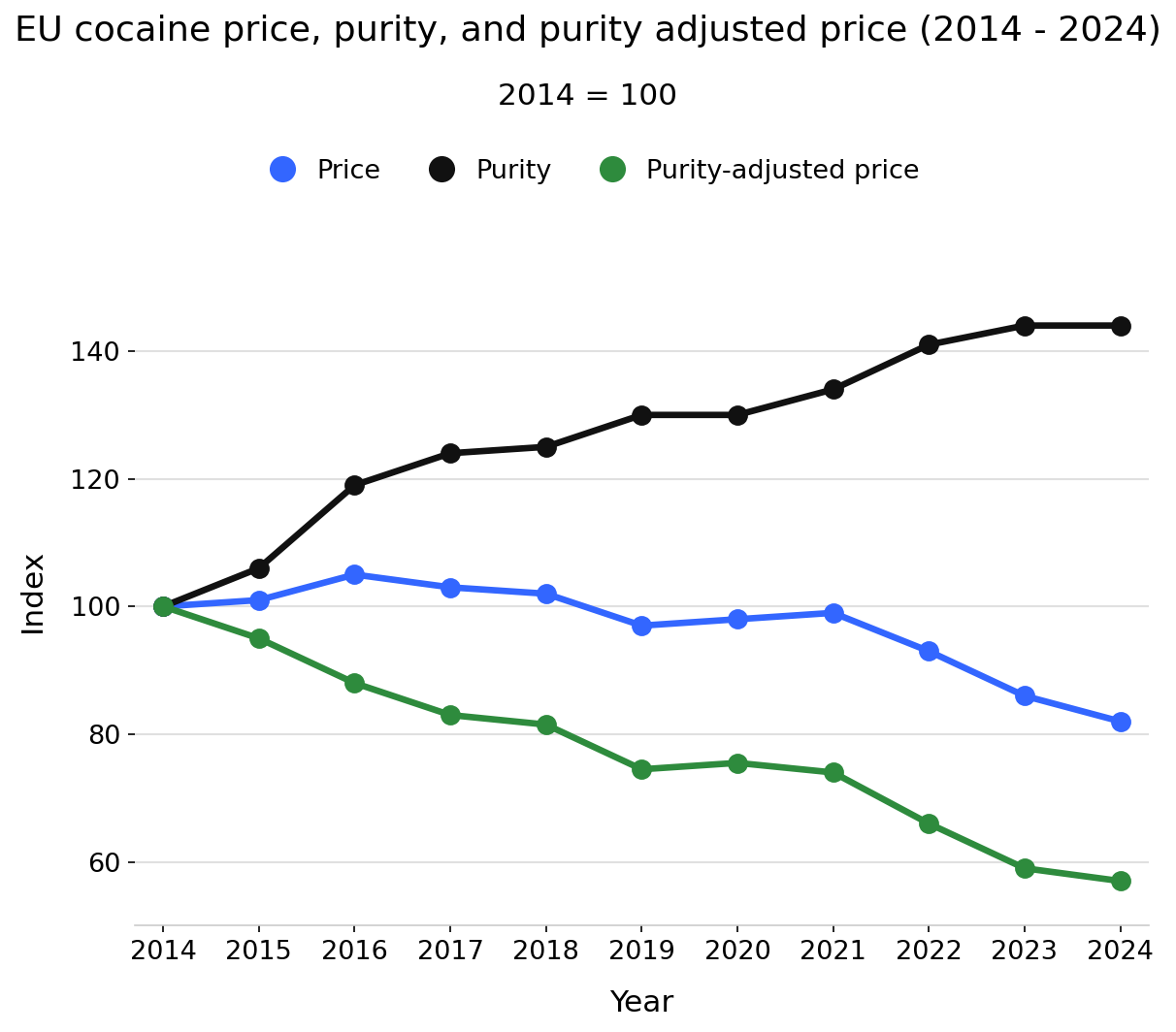
The European Union Drug Agency (EUDA) does, however, publish price and purity trend data from EU member states indexed from a baseline in 2014 (see Figure 3) which can be assumed to be a reasonable proxy for changes in the UK market which are thought to be supplied via many of the same organised crime networks. This shows that cocaine at an EU level is 44% purer and 18% cheaper, producing an overall purity-adjusted price fall of 43% over the 11-year monitoring period. The indexed rise in purity from 134 to 144 during the WAND study period (2021- 25) is less than 10%. The indexed rise in purity between 2017-18 (when the Black review data was gathered) and 2025, from 125 to 144, is around 15%.
Discussion and conclusion
We can reasonably assume that the Black review estimates (adjusted for the whole UK, and population growth in the past decade) are a substantial underestimate, even if they can serve as a useful lower estimate. Other survey data sources such as the ALSPAC data suggests that the primarily CSEW data-derived estimates are potentially undercounting by a factor of two or more.
By contrast, the WAND estimates seem somewhat likely to be an overestimate - potentially from sampling that favours higher consumption urban areas; from translating increases in purity into increases in market value (as opposed to better value from falling purity adjusted price); or from other methodological uncertainties in what is a new and evolving analytical field.
Comparing the UK estimates to equivalent EU estimates can potentially provide some perspective, although the EU data is subject to similar methodological challenges. With a population of 450 million, more than six times that of the UK, the most recent estimate of EU-wide consumption (from EMCDDA, the forerunner of the renamed EUDA) is from 2020, at 158 tonnes, with a market valuation of 10.5 billion euros, a figure that was updated to 11.6 billion Euros for 2022-23. This estimate for the whole of the EU is not much greater than the UK wastewater figure for 2025 (adjusted at 146 tonnes). Even factoring in the UK’s relatively high rate of use compared to the rest of the EU, and EU market growth since 2020, the estimates are orders of magnitude apart. The EUDA no longer use wastewater data to make such estimates and indeed, cautions against it.
Cocaine seizure data may also help provide some useful context for interpreting the different estimates. Seizures can, however, significantly reflect enforcement activity, and can be easily distorted by a small number of mega-seizures (or their absence), and are a very imprecise measure of consumption and market value. In the UK, cocaine seizures rose from around 18 tonnes in 2023, to 28 tonnes in 2024, before falling back to 18 in 2025. The seizure figures for the whole EU are much higher - above 300 tonnes annually since 2021, with a peak of 419 tonnes in 2023. This difference is likely due to seizure interceptions in key EU sites serving the entire EU market as well as trans-shipments to the UK, compared to UK seizures, assumed to be mostly for the UK market only. That the seizure levels for the EU are so much higher than the earlier estimates for total EU consumption perhaps suggests that those estimates were some way off the mark. But without knowing what proportion of total cocaine production and consumption the seizures represent, speculation may not be very productive.
Without additional data sources and analysis to triangulate, it is impossible to know with any degree of certainty at what point between (or potentially beyond) the two available UK estimates the real UK market size figure lies. The UK Government has not attempted to reconcile the conflicting estimates (publicly at least), and there is no formal guidance on best practice for making such estimates offered by either UNODC, or EUDA. Notably, neither drug agency currently produces such estimates. The best we can do given available data is to assume these two estimates provide useful upper and lower thresholds, and assume some point between them as a ‘best guess’ estimate. A median figure is arguably the most reasonable working assumption in this context, giving an estimate for the UK cocaine market is 94.85 tonnes of annual consumption, with a market sales value of £7.7billion.
This blog is an edited extract from the Transform report 'High Returns: the Economic Impacts of UK Cocaine Regulation', published by Transform November 2nd 2026.